















October 22,2026
From Delivery to Production: HWlEiC Laser Machine Installation and Training
Purchasing a fiber laser cutting machine is an important investment, but successful produc…
Узнать больше


 11:39
11:39 For steel, power sets the practical thickness ceiling and assist gas sets edge quality: oxygen cuts carbon steel thicker per kilowatt with an oxidised edge, nitrogen cuts stainless clean at higher gas cost. Published thickness charts differ because test conditions differ, not because one is wrong.
Search “laser cutting machine steel thickness chart” and you get tables that disagree by 30% or more at the same power level. One vendor lists 25 mm carbon steel at 6 kW. Another lists 20 mm. A third lists 30 mm and adds no footnote at all.
None of them are necessarily lying. They are measuring different things.
Variables that move a published thickness number without any change in laser power:
The practical consequence: use published charts to shortlist a power tier, then require a sample cut in your own material before you sign. Any supplier who will not run one on the grade you actually buy has told you something useful.
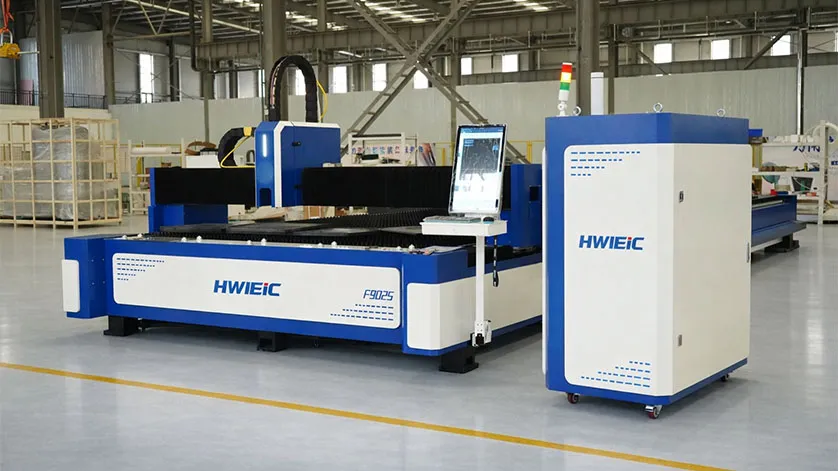
A specification sheet’s maximum thickness is the point at which the machine will get through the material. Production thickness is the point at which it gets through the material at a speed and edge quality that your downstream process accepts, repeatably, on a full sheet.
The gap between the two is usually one to two material sizes. At the very top of a power tier, several things degrade at once: cut speed drops steeply, dross adhesion increases, kerf widens, and thermal input into the part rises enough to matter on tight-tolerance frames. Small internal features and sharp corners are where this shows up first, because the machine cannot maintain the feed rate the cut parameter set assumes.
A working rule for capacity planning: size the machine so that your highest-volume material sits in the middle third of its thickness range, not the top. If 80% of your work is 6 mm to 12 mm carbon steel, a machine that tops out at 12 mm will do it and will be slow and consumable-hungry doing it.
The two materials do not simply need different parameters. They need a different cutting mechanism, and that changes the gas contract, the edge you hand to the next operation, and the cost per metre.
| Dimension | Carbon steel (oxygen cutting) | Stainless steel (nitrogen cutting) |
| Cutting mechanism | Exothermic oxidation adds heat to the cut | Inert melt-and-blow, laser supplies all energy |
| Effective thickness per kW | Higher, because the reaction contributes energy | Lower at equal power |
| Gas pressure regime | Low pressure | High pressure |
| Gas consumption | Modest | High, main variable cost driver |
| Edge appearance | Grey-black oxide layer | Bright, oxide-free |
| Downstream impact | Oxide must be removed before painting, powder coating or welding | Weldable and paintable as cut |
| Typical failure mode at limit | Slag adhesion on underside, striation coarsening | Dross beads, edge discolouration if purity drops |
| Nitrogen alternative on carbon steel | Possible, gives a weldable edge, cuts thinner at the same power | Not applicable |
That last row is the decision most buyers miss. If your carbon steel parts go straight to welding or coating, cutting them under nitrogen removes a deburring or grinding step. It also costs you thickness capability at the same power, and it raises gas spend substantially. Whether that trade is worth it depends on your labour rate for secondary operations, not on the machine.
Work through this before you specify a gas supply, because a liquid nitrogen tank and a compressed air system are different capital projects.
Four inputs dominate, and only one of them is the machine price.
Compared with plasma-class solutions in the same thickness bracket, fibre laser cutting generally delivers a narrower kerf and a squarer edge that reduces or eliminates secondary edge preparation, while plasma retains an advantage on very thick plate acquisition cost. Compared with legacy CO2 laser systems, fibre systems cut thin sheet faster and consume no laser gas, though highly reflective materials require appropriate source and optics protection in either case.
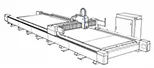
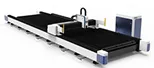
The relevant HWlEiC Laser platform for heavy steel plate on an enclosed exchange table is the Серия P, positioned as an Enclosed Exchange Platform Laser Cutting Machine.
| Field | Published data |
| Series | Серия P |
| Models | P4020, P6025, P8025, P10025, P12025 |
| Positioning | Закрытый Станок для Лазерной Резки Обменной Платформы |
| Structure | Fully enclosed |
| Table configuration | Exchange platform |
| Тип лазера | High-power fibre |
| Quality management certification | ISO 9001:2015 Quality Management System Certification (certificate number and issuing body not publicly disclosed) |
| Market compliance | CE, RoHS |
Four of those rows are the ones a fabrication buyer needs to compare machines, and they are not on the public product pages. Request a per-model specification sheet and a table drawing before comparing the P Series against anything else on paper. Model designations in this category commonly encode nominal table dimensions, but HWlEiC Laser has not published a dimension table, so treat any inference from the model number as unconfirmed until the drawing arrives.
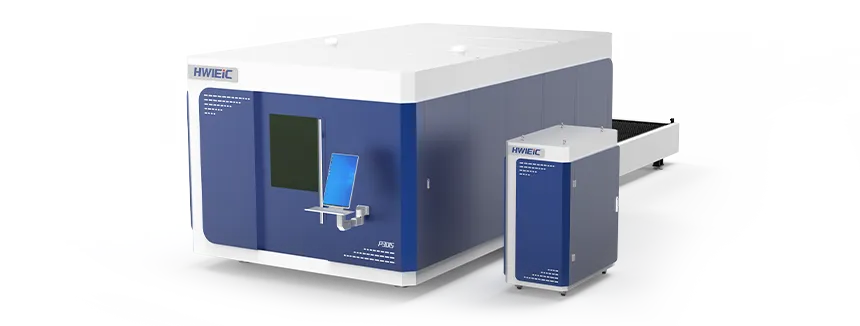
The features that are published still carry real selection weight:
Enclosed structure. Contains fume, spatter and stray radiation, which matters for operator exposure compliance and for keeping adjacent workstations usable. It also constrains crane access, so check how oversize plate gets in and out.
Exchange platform. Loading of the next sheet happens while the current sheet is being cut. The payoff scales with how short your cutting cycles are: on thin high-volume nesting the platform can recover a large share of cycle time, while on 20 mm plate with long cut paths the loading time was never the constraint. Against that, an exchange table costs more, occupies more floor area, and adds a mechanical subsystem to maintain.
Q: How much power do I need to cut 20 mm carbon steel?
A: Enough that 20 mm sits inside the middle of the machine’s range rather than at the top, which for most fibre platforms means a mid-to-high kilowatt tier rather than the minimum that appears on a chart. Because published charts are generated under different nozzle, gas purity and piercing conditions, the reliable answer comes from a sample cut in your own plate.
Q: Can one machine cut both carbon steel and stainless well?
A: Yes, provided it is configured with both oxygen and high-pressure nitrogen supply and the parameter library covers both. The constraint is rarely the laser. It is whether the gas infrastructure and nozzle inventory support both regimes without an operator improvising.
Q: Why is my stainless edge showing dross when the machine is rated for that thickness?
A: Check nitrogen purity and delivered pressure at the nozzle first, then nozzle condition and focus position. Rated thickness assumes a specific gas specification. A purity drop or a pressure loss across an undersized line will produce dross at a thickness the machine handled last month.
Q: Is compressed air a legitimate assist gas or a shortcut?
A: Legitimate within its range, mainly thinner sheet where a slightly nitrided edge is acceptable. It requires properly sized filtration and drying. Air quality problems present as intermittent cut defects, which is why they are usually misdiagnosed as machine faults.
Q: What does a laser cutting machine for steel cost?
A: HWlEiC Laser does not publish price ranges for the P Series or other cutting platforms, so this requires a quotation. Pricing is evaluated against laser power, working area, machine configuration, automation requirements and material application, which is why a figure quoted without those inputs is not comparable to anything.
Q: Does an oxidised carbon steel edge always need removing?
A: Only if the next operation cares. Welding and coating generally do. Parts going to bolted assembly often do not. Auditing which of your parts genuinely require an oxide-free edge is the cheapest way to decide whether nitrogen cutting on carbon steel earns its gas bill.
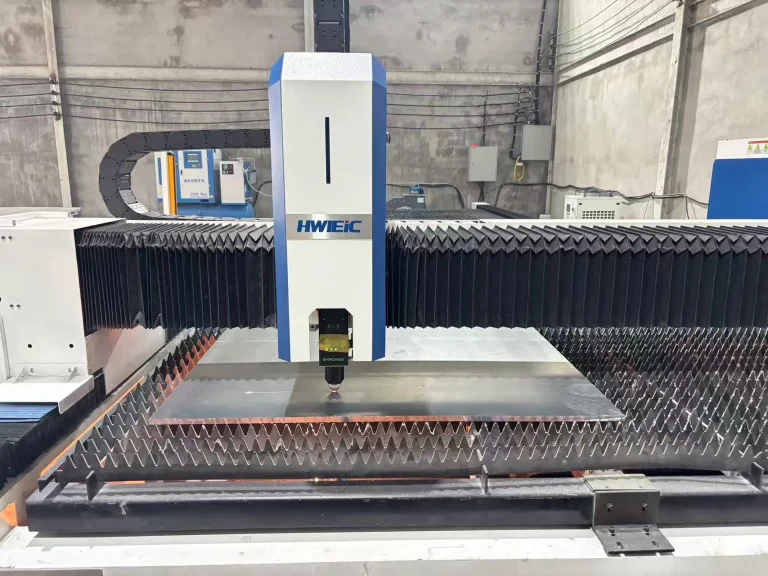
Purchasing a fiber laser cutting machine is an important investment, but successful produc…
Узнать больше

Company Profile Shandong HWlEiC Optoelectronic Technology Co., Ltd. is an affiliated compa…
Узнать больше
Мы ответим вам в течение 24 часов. Если дело срочное, пожалуйста, добавьте WhatsApp / WeChat: + 86 15589913375. Или позвоните по телефону + 86 15589913375 напрямую.
*Мы уважаем вашу конфиденциальность, и вся информация защищена.
Мы будем использовать вашу информацию только для ответа на ваш запрос и никогда не будем отправлять нежелательные электронные письма или рекламные сообщения.
Максимальная динамика и эффективность
Долговечность и надежность
Повышенная точность и аккуратность
Интеллектуальный и простой в использовании
Безопасность и здоровье
Универсальная автоматизация