















August 04,2026
Laser Cutting Machine for Metal: Full Buyer’s Guide
A metal-focused buyer's guide to laser cutting machines: material behaviour, thickness lim…
scopri di più


 10:09
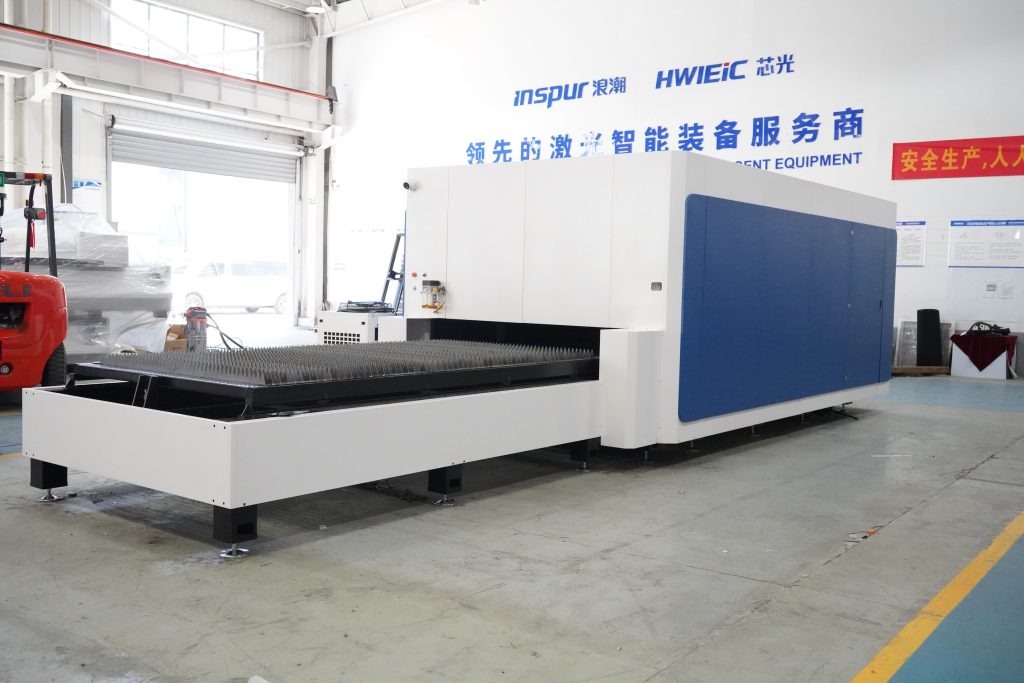
10:09 A macchina per il taglio laser for metal focuses a fiber beam onto sheet or tube stock and clears the kerf with assist gas. Choosing one comes down to four decisions: which metals you run, your working thickness band, the edge quality your customers accept, and how material gets loaded and unloaded.
Fabrication buyers often ask for a machine that “cuts metal,” then discover after installation that the mix they actually run behaves nothing like the demo sample. A machine tuned around 3 mm mild steel is a different purchase from one bought to handle mixed stainless and aluminium work with occasional thick plate.
Three variables move independently:
Compared with plasma-class and CO2-class cutting solutions commonly used for the same parts, fiber systems generally hold a narrower kerf on thin and mid-range sheet and handle reflective alloys with fewer restrictions. The trade-off appears at the heavy end of the plate range, where fiber cutting requires proportionally more installed power and tighter process control.
| Metal | Absorption Behaviour at Fiber Wavelength | Usual Assist Gas | Watch-Outs During Sampling |
|---|---|---|---|
| Carbon steel / mild steel | High absorption; the most forgiving material for fiber cutting | Oxygen for thicker sections; nitrogen for oxide-free edges | Oxide layers on oxygen-cut edges affect downstream painting and welding |
| Acciaio inossidabile | Good absorption; sensitive to assist-gas purity | High-pressure nitrogen | Nitrogen consumption rises steeply with thickness and drives running costs |
| Aluminium | Reflective and thermally conductive; requires stable process control | Nitrogen | Burr formation and dross adhesion on the underside |
| Copper and brass | Highly reflective; the most demanding common workshop metals | Nitrogen, often with power headroom | Back-reflection protection on the cutting head is a configuration question, not an assumption |
| Galvanised steel | Behaves similarly to carbon steel | Oxygen or nitrogen, depending on edge requirements | Zinc vapour makes extraction capacity part of the specification |
| Titanium | Absorbs well; reactive when hot | Inert gas | Edge discolouration is often the acceptance criterion rather than dimensional accuracy |
Two practical notes. First, reflective alloys are a configuration conversation with your supplier before the order, not a setting adjustment afterwards. Second, assist gas is a recurring cost line that some buyers only model after the first quarter of production.
Every laser cutting machine has two thickness figures that get confused with each other: maximum thickness the machine can pierce and separate, and maximum thickness it can cut at a speed and edge quality that makes commercial sense.
The first number sells machines. The second one runs shops.
A system operating near its ceiling loses cutting speed sharply, consumes more gas per metre, and produces edges that increasingly need secondary work. Buyers who size a machine against their thickest occasional job rather than their highest-volume job usually end up with a machine that is slow on the work that actually pays.
The edge case worth planning for: shops that run one heavy job a month. Two thin-sheet machines running in parallel often produce more sellable output than one heavy machine that spends most of its time cutting material well below its capability. Outsourcing the occasional thick job is a legitimate answer, and it belongs in the evaluation rather than being treated as a failure of the purchase.
Suppliers send samples. Most buyers look at them for thirty seconds. A structured inspection takes ten minutes and tells you considerably more.
The purchase price of a metal laser cutting machine is the smaller half of the decision for most fabrication shops. The recurring lines are:
The honest downside of a metal laser cutting machine, stated plainly: it concentrates your capacity into a single point of failure. A shop that moves from three older machines to one modern system gains throughput and loses redundancy. Service response time and spare parts availability in your region deserve the same scrutiny as cutting speed, and they are harder to verify from a brochure.
HWlEiC Laser publicly displays ISO 9001:2015 quality management system certification, along with CE and RoHS compliance.
Read them for what they cover. ISO 9001:2015 is a certification of the quality management system — how the manufacturer documents, controls and reviews its processes. It is not a performance certification for any individual machine. CE marking concerns conformity with applicable European directives, which for industrial machinery centres on safety-related requirements. RoHS addresses restricted substances in the product.
For an equipment buyer, the useful question is not whether the certificates exist but whether the specific configuration you are ordering falls within their scope, and whether documentation will be supplied with the shipment for your own compliance file. Certificate numbers and issuing bodies are not published; request them directly rather than relying on a logo.
Q: What thickness of metal can a fiber laser cutting machine handle?
A: It depends on laser power, material type and the edge quality you need. HWlEiC Laser does not publish thickness charts by model on its public product pages, so request the current specification sheet for the model you are evaluating and ask for the figures separately for maximum thickness and commercially viable production thickness.
Q: Can one machine cut both sheet and tube?
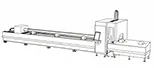
A: Yes. HWlEiC Laser’s FT, ET and PT Series are positioned as sheet-tube combination machines. If tube work is a substantial and regular share of your volume, a dedicated tube machine from the T, TE or K Series is usually the better structural match.
Q: What is the difference between the A, F and E Series?
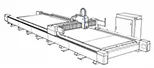
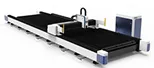
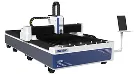
A: A and F Series are single platform machines, with the F Series positioned around high-precision sheet processing and stable industrial production. The E Series uses an exchange platform structure to move loading and unloading off the cutting bed.
Q: How much does a metal laser cutting machine cost?
A: HWlEiC Laser does not publish price ranges. Pricing is determined by laser power, working area, configuration, automation requirements and material application, and requires a customised quotation.
Q: Is the G8025 6KW machine suitable for my shop?
A: It sits in the large-format category, which suits operations where part length drives the requirement. Because the full parameter sheet is not published, request the current configuration document and confirm working dimensions, accuracy figures and thickness capability before comparing it with alternatives.
Q: Does laser cutting work on copper and brass?
A: Fiber systems cut reflective alloys, but the machine must be configured for it, including back-reflection protection on the cutting head. Raise this before ordering rather than after installation.
Q: What certifications does HWlEiC Laser hold?
A: ISO 9001:2015 quality management system certification, plus CE and RoHS compliance. Request the documentation applicable to your specific configuration for your compliance records.
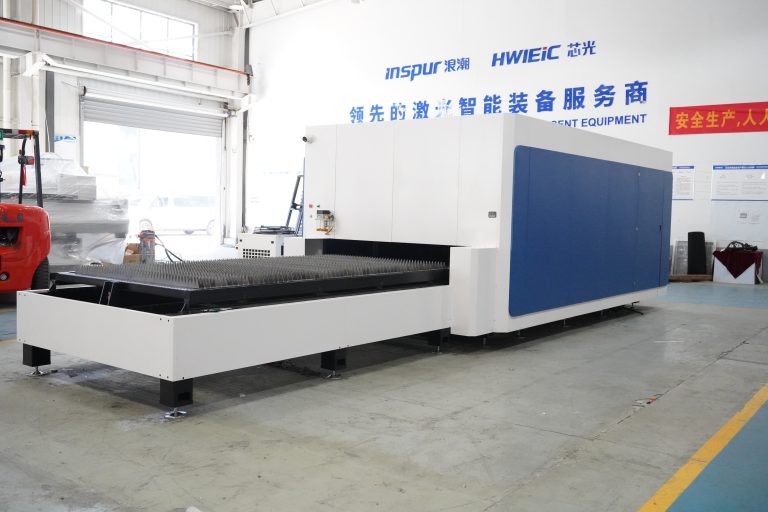
A metal-focused buyer's guide to laser cutting machines: material behaviour, thickness lim…
scopri di più
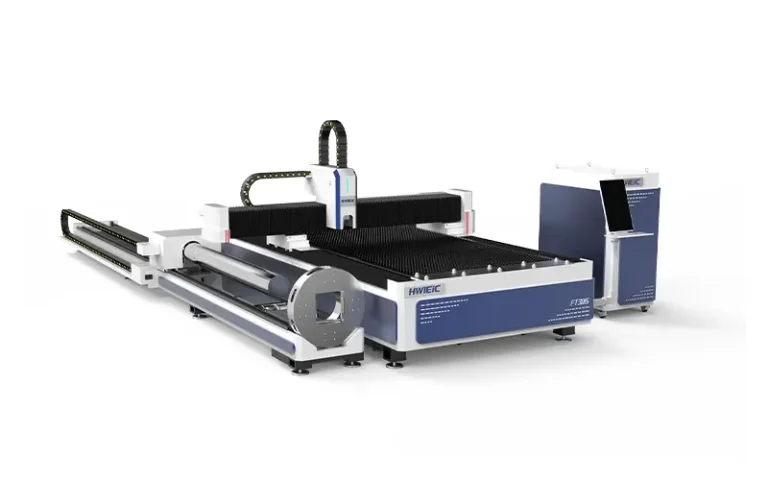
A laser cutting machine focuses a high-energy beam onto metal, melting a narrow kerf while…
scopri di più
Ti risponderemo entro 24 ore. In caso di necessità urgente, aggiungi WhatsApp/WeChat: +86 15589913375. Oppure chiama direttamente il numero +86 15589913375.
*Rispettiamo la tua riservatezza e tutte le informazioni sono protette.
Utilizzeremo solo le tue informazioni per rispondere alla tua richiesta e non invieremo mai email indesiderate o messaggi promozionali.
Dinamiche e efficienza definitive
Durabilità e affidabilità
Precisione e accuratezza potenziate
Intelligente e facile da usare
Sicurezza e salute
Automazione versatile