















October 22,2026
From Delivery to Production: HWlEiC Laser Machine Installation and Training
Purchasing a fiber laser cutting machine is an important investment, but successful produc…
en savoir plus


 10:49
10:49 Un fiber laser cutting machine generates a roughly 1.07-micron beam inside a doped fiber and delivers it through a cable to the cutting head. That wavelength is absorbed well by steel, stainless, aluminium, brass and copper. Running cost is driven mainly by assist gas, electricity and optical consumables rather than by the laser source itself.
The laser source is an optical fiber doped with a rare-earth element, pumped by diodes. The fiber both generates and guides the beam, so there is no free-space resonator with mirrors to align. The beam travels down a delivery cable to a cutting head, where a collimator and focus assembly bring it to a spot on the workpiece. A nozzle sits below the focus optics and pushes assist gas coaxially into the kerf.
Three physical consequences follow from that architecture, and they explain most of what buyers care about. Beam delivery by cable removes the mirror path that older resonator machines needed maintained. The short wavelength is absorbed more readily by metals than the long-wavelength beam of a CO₂ machine. And the small focused spot concentrates energy into a narrow kerf, which is why thin sheet cuts fast and why the process is unforgiving about focus position.
The part of the machine that most affects your production numbers is not the source. It is the motion system, the head, the gas supply and the extraction — the subsystems that determine acceleration on small contours, how consistently the focus holds over a shift, and how much nitrogen you burn.

Copper, brass and polished aluminium reflect long-wavelength light strongly. On a CO₂ machine at 10.6 microns, that reflection historically made these metals difficult and, in some configurations, hazardous to the resonator. At 1.07 microns, absorption is high enough that the pierce establishes quickly and the cut proceeds.
This is why “can it cut copper” became the standard yardstick when fiber machines entered general fabrication. The honest answer is conditional. Copper and brass do cut, but they demand tighter control of pierce parameters than mild steel, tolerate less variation in standoff, and put more back-reflected energy into the head and source than steel does. Sources intended for regular reflective work include optical isolation for that reason.
Two practical items to settle with a supplier before you commit to a copper job:
Neither question has a universal answer. Both belong in writing.
| Material | Typical behaviour | Usual assist gas | Notes |
| Mild / carbon steel | Cuts across a wide thickness range | Oxygen for thicker plate, air or nitrogen for thin | Oxygen adds an exothermic contribution; edge carries an oxide layer |
| Acier inoxydable | Clean, oxide-free edges achievable | Nitrogen at high pressure | Nitrogen consumption climbs steeply with thickness |
| Aluminium | Cuts well; dross control is the main variable | Nitrogen | Alloy and surface condition affect results more than with steel |
| Brass and copper | Cuts with correct source and pierce control | Nitrogen | Back-reflection handling is the limiting factor, not absorption |
| Galvanised steel | Cuts; zinc vapour is the issue | Air or nitrogen | Extraction capacity and filter life matter here |
| Acrylic, wood, most plastics | Poor to unusable | — | Absorption at 1.07 µm is wrong for these; this is CO₂ territory |
| Glass, ceramics | Not applicable | — | Different process entirely |
The last two rows matter more than they look. A workshop that also engraves acrylic signage cannot consolidate onto one fiber machine. That job needs a separate CO₂ machine or a desktop engraver, and discovering it after purchase is an expensive way to learn.
Compared with the category pages most established machine builders publish, which are detailed on their own model tables but thin on neutral process comparison, the useful framing is not “which technology wins” but “which four questions decide it”.
| Decision point | Laser à fibre | CO₂ laser | Plasma |
| Metals it suits | Steel, stainless, aluminium, brass, copper | Steel and stainless; reflective metals problematic | Conductive metals only |
| Non-metals | Not suitable | Acrylic, wood, textiles, some plastics | Not suitable |
| Edge quality on thin sheet | Narrow kerf, tight tolerance achievable | Good, wider kerf than fiber | Wider kerf, bevel and dross typical |
| Very thick plate | Limited by machine power and configuration | Limitée | Often the more economical route |
| Beam path maintenance | Cable delivery; no mirror alignment | Mirror path requires alignment and cleaning | No beam path |
| Consumable character | Optics, nozzles, filters | Optics, mirrors, laser gas | Electrodes and swirl rings, high replacement frequency |
Read that table by column and you get a marketing comparison. Read it by row and you get a specification decision. If your part mix is thin stainless with tight tolerance, the fiber row wins on two rows and the others are irrelevant. If half your volume is 40 mm structural plate, the thick-plate row may point elsewhere regardless of what the rest of the table says.
Buyers ask for a cost-per-hour number. No supplier can give you a truthful one, because four of the five inputs are yours, not theirs. What you can get is the structure, and then fill it with your own tariffs.
Hourly running cost ≈ electrical draw × your tariff + gas consumption × your gas price + (consumable spend ÷ hours between replacement) + (maintenance labour ÷ interval) + capital recovery per productive hour
Working through the terms:
The maintenance load on a fiber machine is lighter than the resonator machines it replaced, which is a fair claim, but “lighter” is not “none”. A realistic picture of ongoing attention:
Daily to weekly: inspect the protective lens for spatter and damage, clear slag from the slat bed, check nozzle condition and centring, empty the scrap drawer, confirm the chiller is holding temperature.
Monthly to quarterly: clean or replace extraction filters depending on material mix, check rails and rack for debris and lubrication, verify chiller coolant condition, inspect the gas line and regulators for leaks.
Annual or condition-based: slat replacement once kerf accuracy suffers, drive belt and gear inspection, calibration verification against a known test pattern, coolant change.
Two items catch shops out. Extraction filter cost over a year, on a material mix heavy in galvanised or painted stock, can be a larger line than optics. And chiller performance is ambient-dependent — a unit that holds temperature in winter may derate in an uninsulated plant in mid-summer, which shows up as inconsistent edge quality rather than as an alarm.
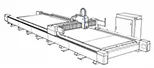
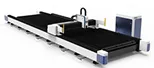
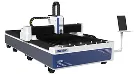
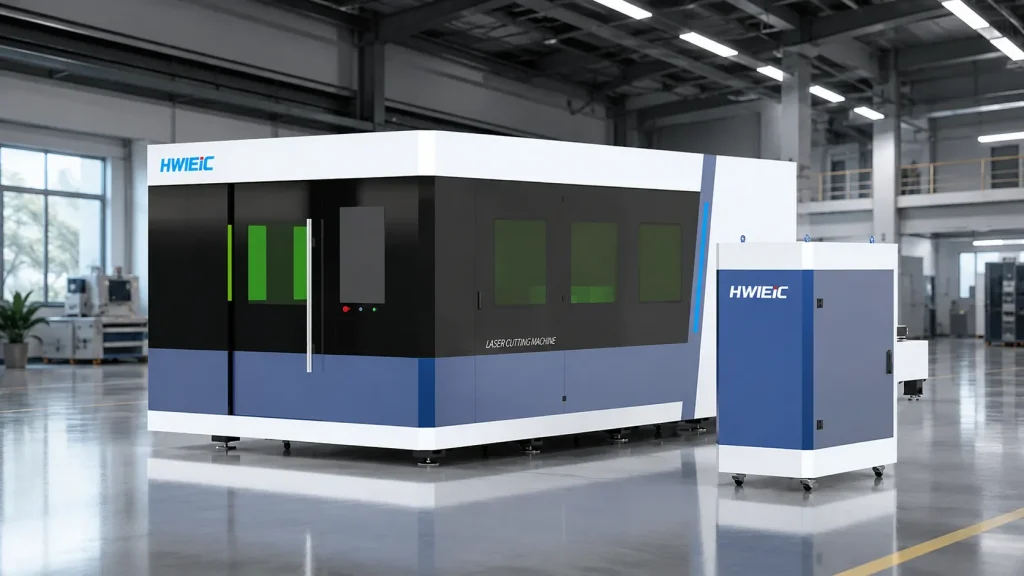
Le Série PH is HWlEiC Laser’s high-speed fiber cutting range, positioned for continuous sheet metal production rather than intermittent job-shop work.
| Item | Published position |
|---|---|
| Models | PH3015, PH6020, PH6025 |
| Positioning | Machine de découpe laser à fibre à grande vitesse |
| Design focus | High-speed sheet metal cutting; industrial continuous production; high-efficiency processing |
Quality system and market compliance are documented: HWlEiC Laser holds ISO 9001:2015 quality management system certification, with CE and RoHS compliance declared for the equipment range. ISO 9001:2015 governs the consistency of the manufacturing and inspection process, not the performance of any individual machine, and the two are worth keeping separate when you evaluate a supplier.
Machine pricing across the industrial range depends on laser power, working area, machine configuration, automation requirements and material application. Quotation requires a customised evaluation rather than a list price.
“More kilowatts always means lower cost per part.” Higher power shortens the cut on thick material. On thin sheet the constraint is often acceleration, pierce count and part handling, not beam power. Higher power also tends to run larger nozzles, and larger nozzles consume more gas. Beyond the point where power stops being your bottleneck, the extra kilowatts add gas spend and capital cost without adding parts.
“Nitrogen is a detail.” On a stainless-heavy mix at pressure, nitrogen can become the largest single line in the hourly model. Bulk supply arrangements and nozzle discipline change that number more than any machine setting.
“Fiber means maintenance-free.” It means no resonator mirror path. Optics, filters, slats and coolant remain.
The thickness chart tells me what I can produce.” Maximum cuttable thickness and economically productive thickness are different numbers, sometimes by a wide margin. A machine that can cut a given plate at low speed with a rough edge is not a machine that should be quoted for that job in volume.
A: Yes. The 1.07-micron wavelength is absorbed well enough by copper and brass to cut them, unlike a CO₂ laser at 10.6 microns. The practical limits are back-reflection handling in the source and head, and tighter pierce control than steel requires. Confirm with the supplier that the specific source configuration is rated for continuous reflective-metal work.
A: There is no single figure, because most inputs are site-specific. Build it as electrical draw of the whole cell times your tariff, plus assist gas consumption times your gas price, plus consumables divided by hours between replacement, plus maintenance labour, plus capital recovery per productive hour. On a stainless-heavy mix, nitrogen usually dominates.
A: No, not usefully. Those materials absorb the long 10.6-micron CO₂ wavelength, not the 1.07-micron fiber wavelength. A shop needing both metal cutting and acrylic or wood work needs two different machine types.
A: Daily protective lens and nozzle checks, slag clearing and chiller monitoring; monthly to quarterly filter, rail and coolant attention; annual or condition-based slat replacement and calibration verification. There is no resonator mirror path to align, which is the main reduction compared with CO₂ machines.
A: Laser power by model, working area, cutting thickness by material with the assist gas and edge-quality condition stated, positioning and repeat positioning accuracy, total connected electrical load, gas pressure requirement, and the consumable list with replacement intervals. Thickness claims without gas and quality conditions attached cannot be compared across suppliers.
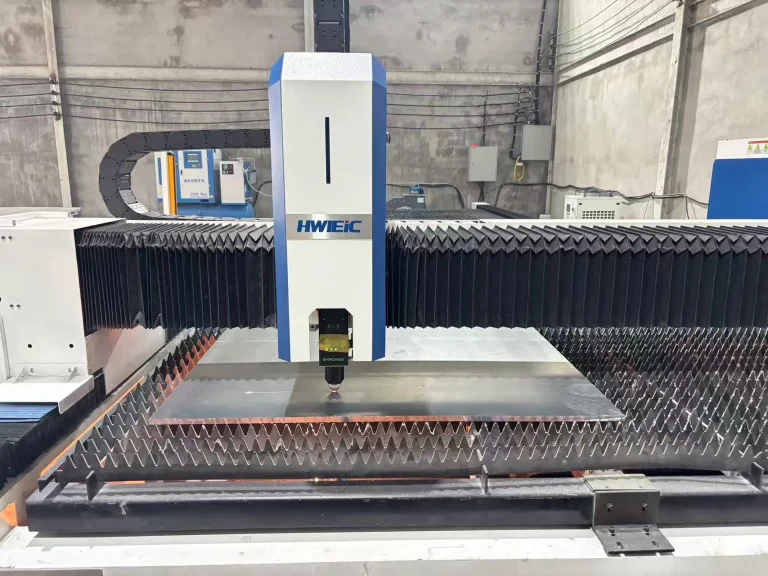
Purchasing a fiber laser cutting machine is an important investment, but successful produc…
en savoir plus

Company Profile Shandong HWlEiC Optoelectronic Technology Co., Ltd. is an affiliated compa…
en savoir plus
Nous vous répondrons dans les 24 heures. Si, pour des cas urgents, s'il vous plaît ajouter WhatsApp/WeChat: +86 15589913375. Ou appelez le +86 15589913375 directement.
*Nous respectons votre confidentialité et toutes les informations sont protégées.
Nous n'utiliserons vos renseignements personnels pour répondre à votre demande et ne seront jamais envoyer des courriels non sollicités ou des messages promotionnels.
Ultime la dynamique et l'efficacité
La durabilité et la fiabilité
Mise à niveau de précision et d'exactitude
Intelligent et facile à utiliser
La sécurité et de la santé
Polyvalent automatisation