















July 25,2026
Laser Cutting Machine Price: What Drives Cost
Laser cutting machine price isn’t a single number you can look up — it’s the o…
pelajari lebih lanjut


 18:37
18:37 Speccing a CNC sheet metal laser cutting machine means matching four things to your actual part mix: sheet format, laser power tier, platform type, and material thickness range. Get the format and platform right first. Power tiers can be adjusted at quotation; a table that cannot hold your sheets cannot be fixed later.
Most vendor category pages open with a maximum: highest kilowatt rating, thickest plate cut. Those numbers describe the ceiling of what a machine can do once, not what it will do eight hours a day on your job floor.
The information that actually constrains the purchase sits in your own production records. Before you look at a single model page, pull the last six to twelve months of work orders and extract:
That last item decides more than the laser source does. A shop where the beam is idle 40% of the shift while an operator clears a table is not short of power. It is short of platform.
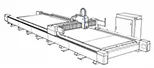
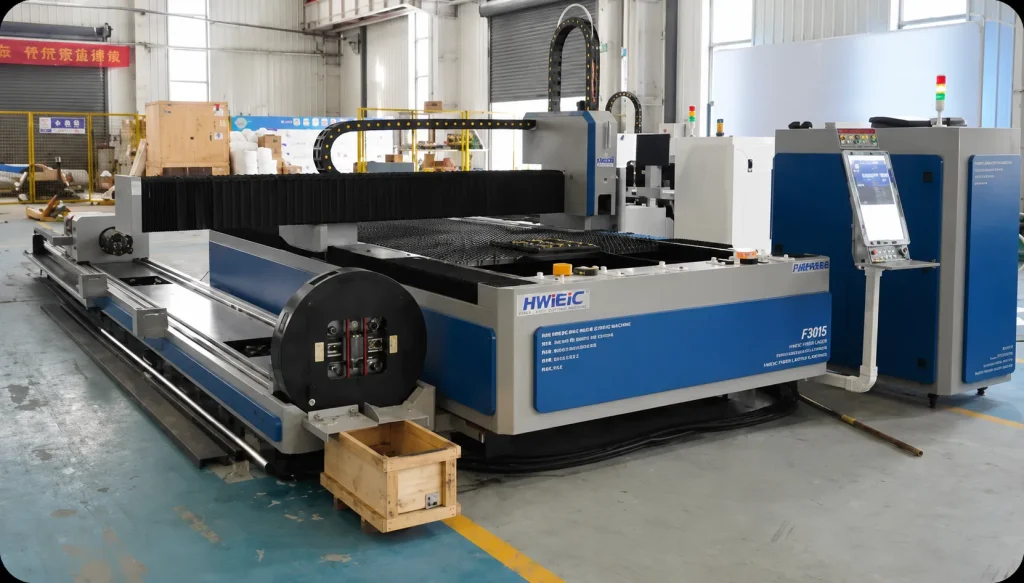
HWlEiC‘s sheet cutting models use a four-digit format code: A3015, A4020, F6015, F6025. Across the sheet metal laser sector this code convention refers to nominal working area, first pair as length and second pair as width, each in units of 100 mm. On that reading, a 3015 designation points at a 3000 × 1500 mm table and a 6025 designation at 6000 × 2500 mm.
Treat that as a reading aid, not a datasheet. HWlEiC does not publish table dimensions, cutting accuracy or maximum thickness on the public A Series and F Series pages, so the exact working envelope, clamping allowance and usable travel for any given model need to be confirmed in writing before you design material flow around them. Ask for the drawing, not the code.
HWlEiC‘s sheet cutting models use a four-digit format code: A3015, A4020, F6015, F6025. Across the sheet metal laser sector this code convention refers to nominal working area, first pair as length and second pair as width, each in units of 100 mm. On that reading, a 3015 designation points at a 3000 × 1500 mm table and a 6025 designation at 6000 × 2500 mm.
Treat that as a reading aid, not a datasheet. HWlEiC does not publish table dimensions, cutting accuracy or maximum thickness on the public A Series and F Series pages, so the exact working envelope, clamping allowance and usable travel for any given model need to be confirmed in writing before you design material flow around them. Ask for the drawing, not the code.
| Model | Series Positioning | Nominal Format Code | Platform Type |
|---|---|---|---|
| A3015 | Basic Single Plane | 3015 | Single platform |
| A4015 | Basic Single Plane | 4015 | Single platform |
| A4020 | Basic Single Plane | 4020 | Single platform |
| A6025 | Basic Single Plane | 6025 | Single platform |
| F3015 | Classic Single Plane | 3015 | Single platform |
| F4020 | Classic Single Plane | 4020 | Single platform |
| F6015 | Classic Single Plane | 6015 | Single platform |
| F6025 | Classic Single Plane | 6025 | Single platform |
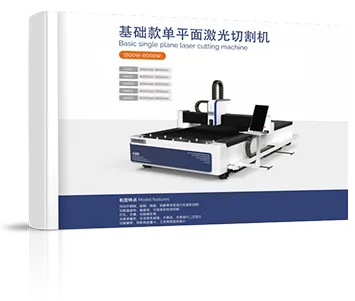
The Seri is described in the catalogue as a basic single plane machine positioned as a practical industrial sheet cutting solution.
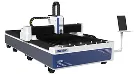
The Seri F is described as a classic single plane machine, with metal sheet cutting, high-precision processing and stable industrial production listed as its characteristics.
Reading that honestly: the catalogue distinguishes the two on intended duty rather than on any published number. The A Series reads as the entry configuration for shops whose format requirement is fixed and whose accuracy requirement is ordinary fabrication tolerance. The F Series reads as the tier above it, where precision and continuous running are called out. Which of those descriptions maps to your parts is a conversation to have with an engineer, with your drawings on the table.
The format spread matters more than the series letter for most buyers. Four of the eight models above are 4020 or larger, and two reach the 6025 code — that range exists because sheet stock purchasing varies by region and by material supplier, not because bigger is better. Buying a 6025 table to cut 1500 mm stock leaves you paying for gantry mass, floor space and enclosure volume that never carries a part.
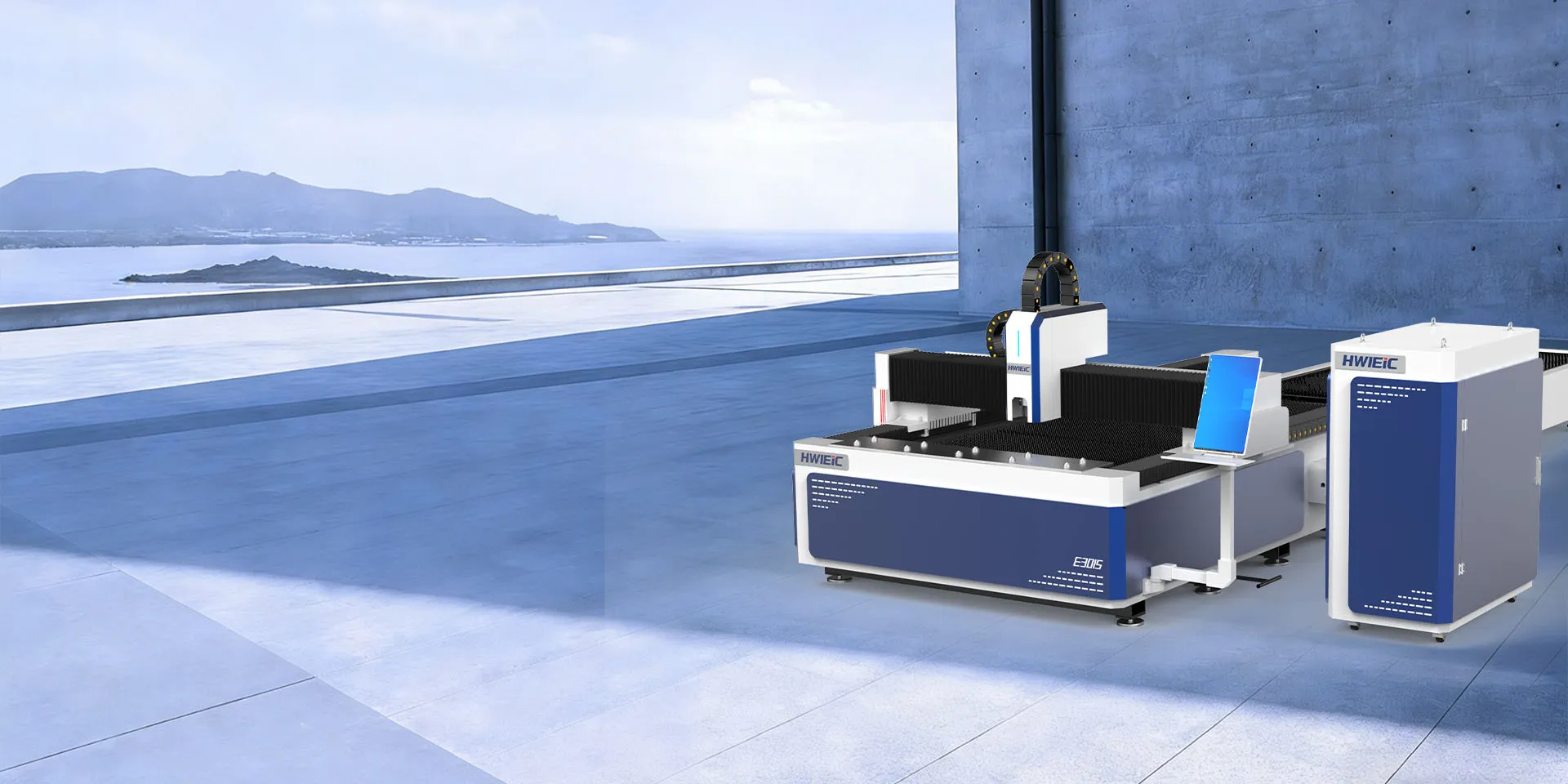
Every model in this guide is single-platform. That is a real constraint and worth stating plainly rather than treating as a footnote.
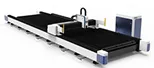
On a single-platform machine, loading and unloading happen on the same table the beam works over. The machine is stopped during that time. On an exchange-platform machine — HWlEiC’s E Series is the catalogue’s exchange table configuration for sheet work — one table is being cut while the other is being cleared and reloaded, and the tables swap.
The test is not sophisticated. Estimate cut time per sheet and handling time per sheet from your own records, then:
Floor space is the counterweight. An exchange platform occupies roughly the footprint of two tables plus swap clearance, and it introduces a mechanism that has to be maintained. Shops that measured a real handling bottleneck rarely regret it.
Shops that bought it because it appeared on the comparison chart usually run it as a single-platform machine with an expensive second table parked underneath.
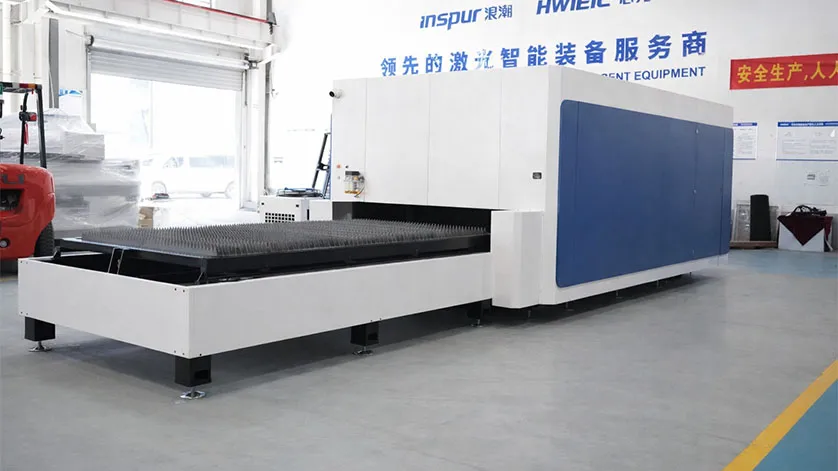
Work through these in order. Each step should end with a number or a decision you can hand to a supplier.
Step 1 — Fix the sheet format. Take the 90th percentile of your raw stock sizes, add your clamping and edge allowance, and round up to the nearest available format code. This produces one or two candidate codes and eliminates the rest of the catalogue. Verification: you can name the model codes still in contention.
Step 2 — Bracket the thickness band. Write down the thickness range covering 80% of parts, and the outlier range separately. Do not spec against the outlier unless it is more than about a fifth of your volume; subcontracting the thick outliers is often cheaper than buying power you use once a week. Verification: two ranges written down, with a percentage against each.
Step 3 — Request the power recommendation.Do not assume it. Give the supplier the two thickness ranges, the materials by name, and your required edge quality and cut speed target. Ask for a recommended power tier against that brief. Verification: you have a written power recommendation tied to your stated materials.
Step 4 — Run the platform test. Compare measured handling time per sheet against estimated cut time per sheet from Step 2. Verification: you have chosen single platform or exchange platform, and can state the ratio that drove it.
Step 5 — Confirm the published envelope in writing. Request working area drawing, positioning accuracy, repeatability, machine footprint including service clearance, and power supply requirement. Where a figure is not on the public page, it must appear on the quotation. Verification: nothing on your spec sheet reads “assumed.”
Step 6 — Specify what happens after installation. Commissioning scope, operator training days, spare parts list for the first year, response time commitment, and consumables availability in your region. Verification: each of these has a named deliverable, not a reassurance.
Speccing to the outlier part. The most common error is sizing the whole machine around the thickest or largest part in the catalogue, which is frequently a legacy job or a one-off. The cost of that decision compounds: larger table, higher power, bigger chiller, more floor, more extraction, higher running cost per part on the 80% of work that never needed any of it.
Reading maximum thickness as production thickness. A stated maximum cut thickness is typically a capability figure, achieved at low feed rate and with a particular assist gas and edge quality. Production thickness — the band a machine runs economically all shift — sits below it. When a supplier quotes a maximum, ask separately what thickness they would run continuously for your quality requirement.
Overlooking assist gas economics. Gas consumption over a machine’s life can rival the acquisition difference between two candidate models, and it varies sharply with material, thickness and required edge finish. Nitrogen-heavy stainless work is a different operating cost profile from oxygen-cut carbon steel. Buyers who compare only equipment quotations are comparing an incomplete number.
An edge case worth flagging: shops running highly reflective materials such as copper and brass. Fiber sources handle reflective metals far better than earlier laser types did, but the specification conversation changes — cutting head protection, permitted thickness on reflective stock, and any warranty conditions attached to it should be raised explicitly and answered in writing before the order. Do not assume a general steel-cutting spec transfers.
HWlEiC Laser holds ISO 9001:2015 quality management system certification, and publicly displays CE and RoHS compliance. Those three signals answer different questions, and it helps to keep them separate.
ISO 9001:2015 is a quality management system standard published by the International Organization for Standardization. It certifies that a manufacturer operates documented, audited processes for design, production and corrective action. It does not certify that any individual machine meets a performance figure — a distinction buyers routinely collapse.
CE compliance addresses conformity with applicable European health, safety and environmental requirements, which matters for import into the EEA and often for insurance and site acceptance elsewhere. RoHS concerns restricted hazardous substances in the equipment.
What none of them tells you is cut quality, uptime or service responsiveness. Certification is a floor to check for, then move past. The questions that predict satisfaction two years in are about spare parts lead time, local engineer availability and whether the supplier will run your parts as a sample before the order.
Compared with the vendor category pages that dominate this search — which publish power and thickness ceilings and leave the matching exercise to the buyer — the sequence above is deliberately boring: format, thickness, power, platform, envelope, aftersales, in that order. It produces a shortlist of two or three model codes rather than a catalogue.
Two things this guide has not covered and you may need next: nesting software and its effect on material yield, which often moves cost per part more than the machine choice does; and automation add-ons such as tower storage or automatic loading, which change the platform calculation entirely and are worth evaluating before, not after, the machine decision is locked.
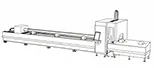
If your part mix includes tube or profile alongside sheet, the specification path diverges early — combination sheet-and-tube configurations exist as a separate product family and should be scoped as one decision rather than two.
Q: What is the difference between the A Series and F Series sheet metal laser cutting machines?
A: Both are single-platform metal sheet cutting machines. HWlEiC positions the A Series as a basic single plane machine for practical industrial sheet cutting, and the F Series as a classic single plane machine with high-precision processing and stable industrial production called out. Detailed power and accuracy specifications are not published on the public product pages and should be requested for the specific models you are comparing.
Q: What sheet size does a 3015 or 6025 model refer to?
A: The four-digit code follows the sector convention of nominal working area in units of 100 mm — 3015 pointing at approximately 3000 × 1500 mm, 6025 at approximately 6000 × 2500 mm. Confirm the exact usable working area and clamping allowance with the supplier before planning material flow, as HWlEiC does not publish table dimensions publicly.
Q: Do I need an exchange platform machine?
A: Compare handling time per sheet against cut time per sheet in your current production. If handling time approaches or exceeds cut time, an exchange table converts idle beam time into output. If cut times are long relative to handling, a single-platform machine such as the A Series or F Series gives up very little. HWlEiC’s E Series is the exchange table configuration in the sheet cutting catalogue.
Q: How much does a CNC sheet metal laser cutting machine cost?
A: Pricing is not published and requires a customized evaluation. Cost is driven by laser power, working area, machine configuration, automation requirements and material application. Sending your sheet format, material types and thickness distribution with the enquiry will produce a specific quotation.
Q: What certifications should I check for?
A: HWlEiC Laser holds ISO 9001:2015 quality management system certification and publicly displays CE and RoHS compliance. Certificate numbers and issuing bodies are not published publicly, so request copies during evaluation. Note that ISO 9001:2015 certifies the manufacturer’s quality processes, not the performance of an individual machine.
Q: Can these machines cut copper and brass?
A: Reflective materials require an explicit conversation about cutting head protection, permitted thickness on reflective stock and any warranty conditions attached. Raise it before the order and get the answer in writing rather than assuming a general steel-cutting specification applies.
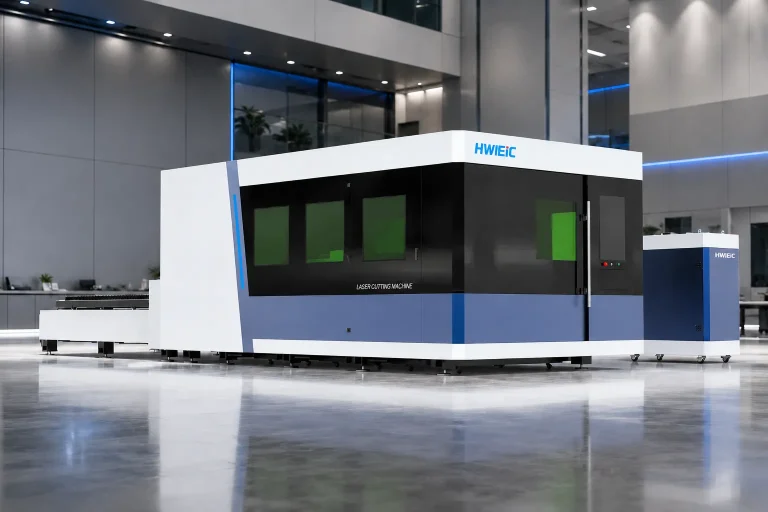
Laser cutting machine price isn’t a single number you can look up — it’s the o…
pelajari lebih lanjut
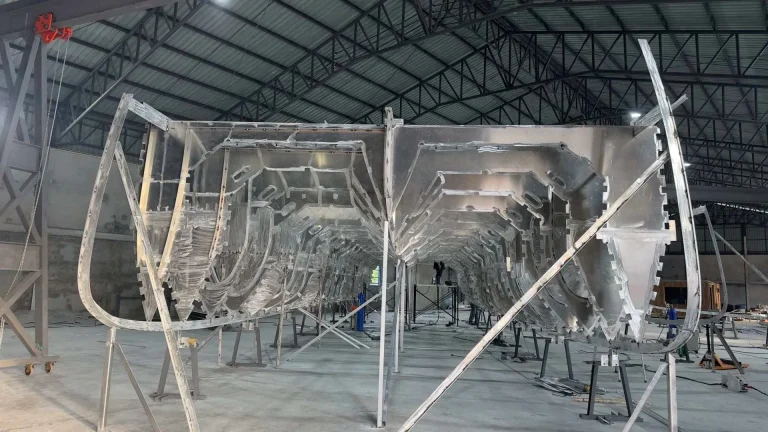
Thailand Customer Upgrades Metal Processing with HWlEiC G8025 6KW Fiber Laser Cutting Mach…
pelajari lebih lanjut
Kami akan membalas Anda dalam waktu 24 jam. Jika untuk kasus mendesak, silakan tambahkan WhatsApp / WeChat: +86 15589913375. Atau hubungi +86 15589913375 secara langsung.
*Kami menghormati kerahasiaan Anda dan semua informasi dilindungi.
Kami hanya akan menggunakan informasi Anda untuk menanggapi pertanyaan Anda dan tidak akan pernah mengirim email atau pesan promosi yang tidak diminta.
Dinamika dan efisiensi tertinggi
Daya tahan dan keandalan
Presisi dan akurasi yang ditingkatkan
Cerdas & mudah digunakan
Keamanan & sehat
Otomatisasi serbaguna