















August 04,2026
Laser Cutting Machine for Metal: Full Buyer’s Guide
A metal-focused buyer's guide to laser cutting machines: material behaviour, thickness lim…
pelajari lebih lanjut


 09:46
09:46 A laser cutting machine focuses a high-energy beam onto metal, melting a narrow kerf while assist gas blows the molten material out of the cut. Buying one comes down to four decisions: material and thickness, sheet or tube, laser power, and table configuration. This guide walks through each of those in order.
The beam leaves the laser source, travels through fiber to the cutting head, and passes through a focusing lens that concentrates it into a spot on the workpiece surface. Metal at that spot heats past its melting point in milliseconds. Assist gas, delivered coaxially through the nozzle, does the rest of the work: it ejects molten material downward and keeps the melt from re-welding behind the beam.
Which gas you use changes the economics of the job more than most buyers expect at the quoting stage.
The CNC controller coordinates the head’s height above the plate (capacitive sensing), the axis motion, the gas valve, and the laser power in one motion profile. Cut quality problems that look like “laser problems” are frequently height-following or nozzle condition problems.
Older industrial cutting relied on CO2 lasers, which emit at roughly 10.6 micrometers. Fiber lasers emit near 1.06 micrometers. That single order-of-magnitude difference in wavelength drives nearly every practical distinction between the two.
| Dimension | Fiber Source (~1.06 µm) | CO₂ Source (~10.6 µm) |
|---|---|---|
| Absorption in steel and aluminum | Tinggi | Lower; more energy reflected |
| Reflective metals (copper, brass) | Cuttable with proper head protection | Historically problematic |
| Beam delivery | Fiber cable to the head | Mirror path requiring alignment |
| Consumables in the beam path | Nozzles and protective glass | Mirrors, lenses, and laser |
Compared with the mirror-delivered systems that dominated metal fabrication a generation ago, fiber machines remove an entire maintenance category — beam path alignment — from the weekly routine. That is the main reason HWlEiC Laser’s cutting portfolio is built on fiber sources rather than a mixed lineup.
Plasma and waterjet still hold ground at the extremes. Plasma is cheaper per hour on heavy plate where edge tolerance is loose. Waterjet cuts anything, including materials a laser cannot touch, and introduces no heat-affected zone. Laser wins the middle band: sheet and structural metal where you need repeatable tolerances and clean edges without secondary machining.
HWlEiC Laser organizes its cutting equipment by what goes on the table rather than by power class. Matching your part mix to the right family is the decision that is expensive to reverse.
| Category | Series | Published Models | Structural Character |
|---|---|---|---|
| Ultra Fiber Laser Cutting | PH | PH3015, PH6020, PH6025 | High-speed sheet cutting for continuous production |
| Ultra Fiber Laser Cutting | P | P4020, P6025, P8025, P10025, P12025 | Fully enclosed, exchange platform, high-power |
| Ultra Fiber Laser Cutting | G | G9020, G12030, G15530, customizable | Large format, heavy fabrication, custom working dimensions |
| Metal Sheet | A | A3015, A4015, A4020, A6025 | Basic single platform |
| Metal Sheet | F | F3015, F4020, F6015, F6025 | Classic single platform, high-precision sheet work |
| Metal Sheet | E | E3015, E4015, E4020, E6015, E6025 | Exchange table |
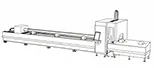
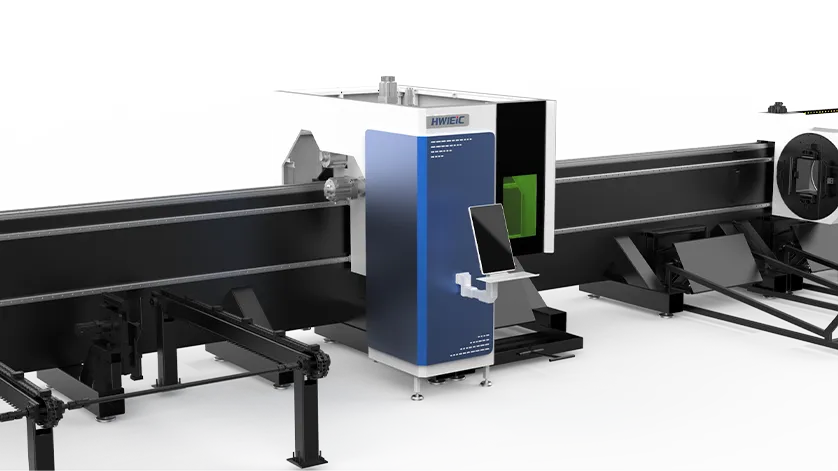
| Tube | T | T6023, T6035 | Dual-chuck tube cutter |
| Tube | TE | TE6023, TE9023, TE12023 | Dual chuck, extended length range |
| Tube | K | K6010, K6012, K6016 | Industrial tube cutting |
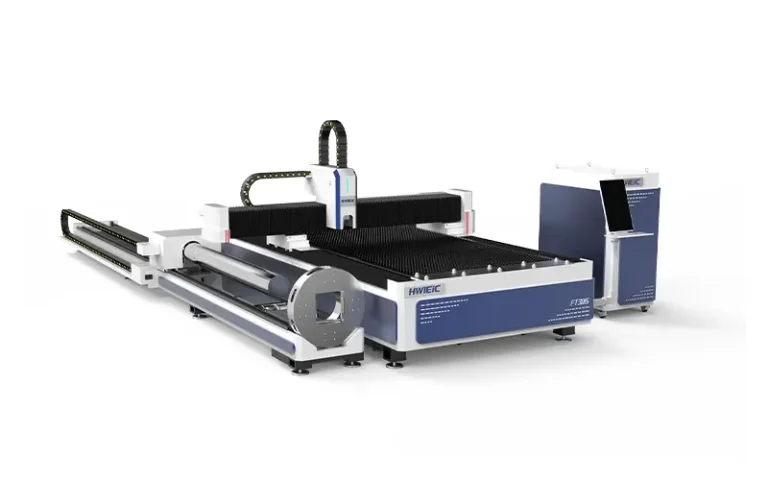
| Sheet-Tube Combo | ET | ET3015, ET4020, ET6025, ET8025 | Open-type combo |
| Sheet-Tube Combo | FT | FT3015, FT4020, FT6015, F6025T, FT8025 | Single-platform plate-and-tube cutting |
| Sheet-Tube Combo | PT | P3015T, P4015T, P4020T, P6015T, P6025T, P8025T | Fully enclosed sheet-and-tube cutting |
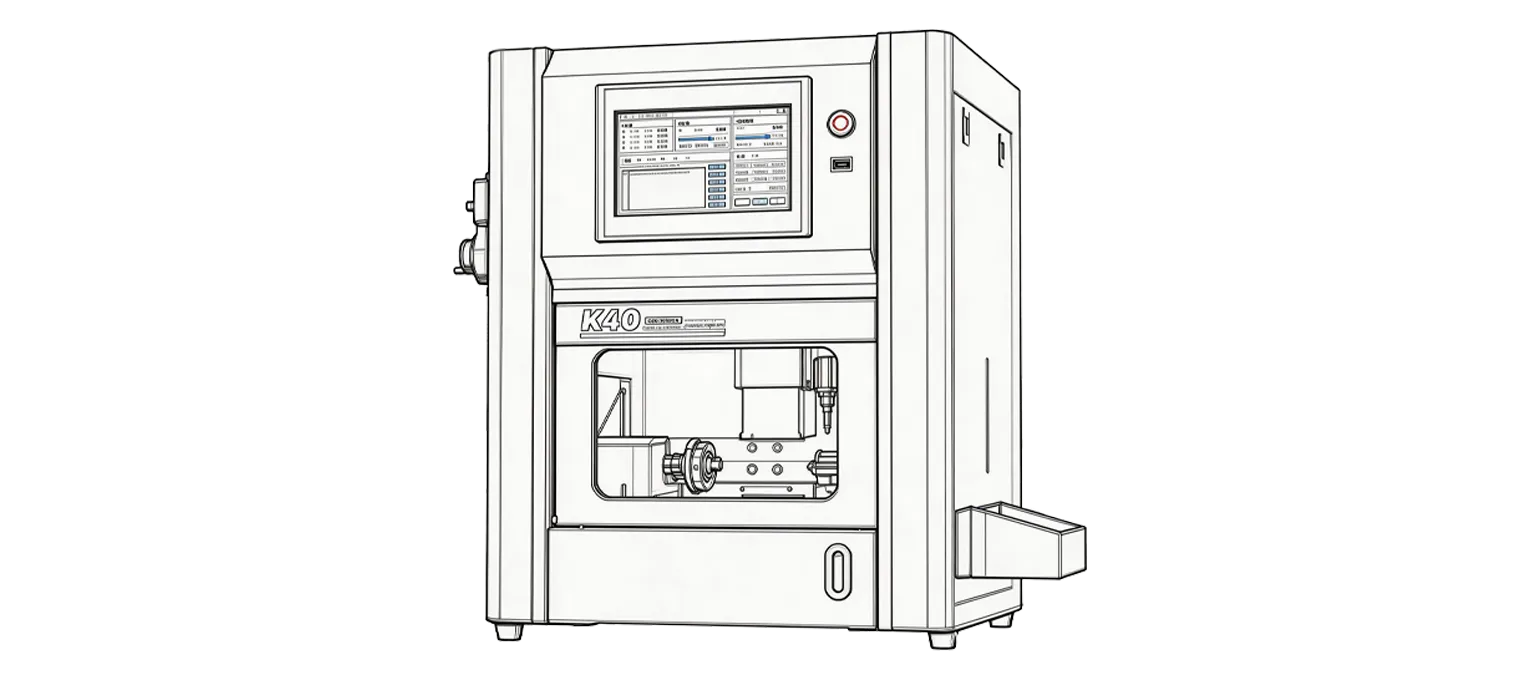
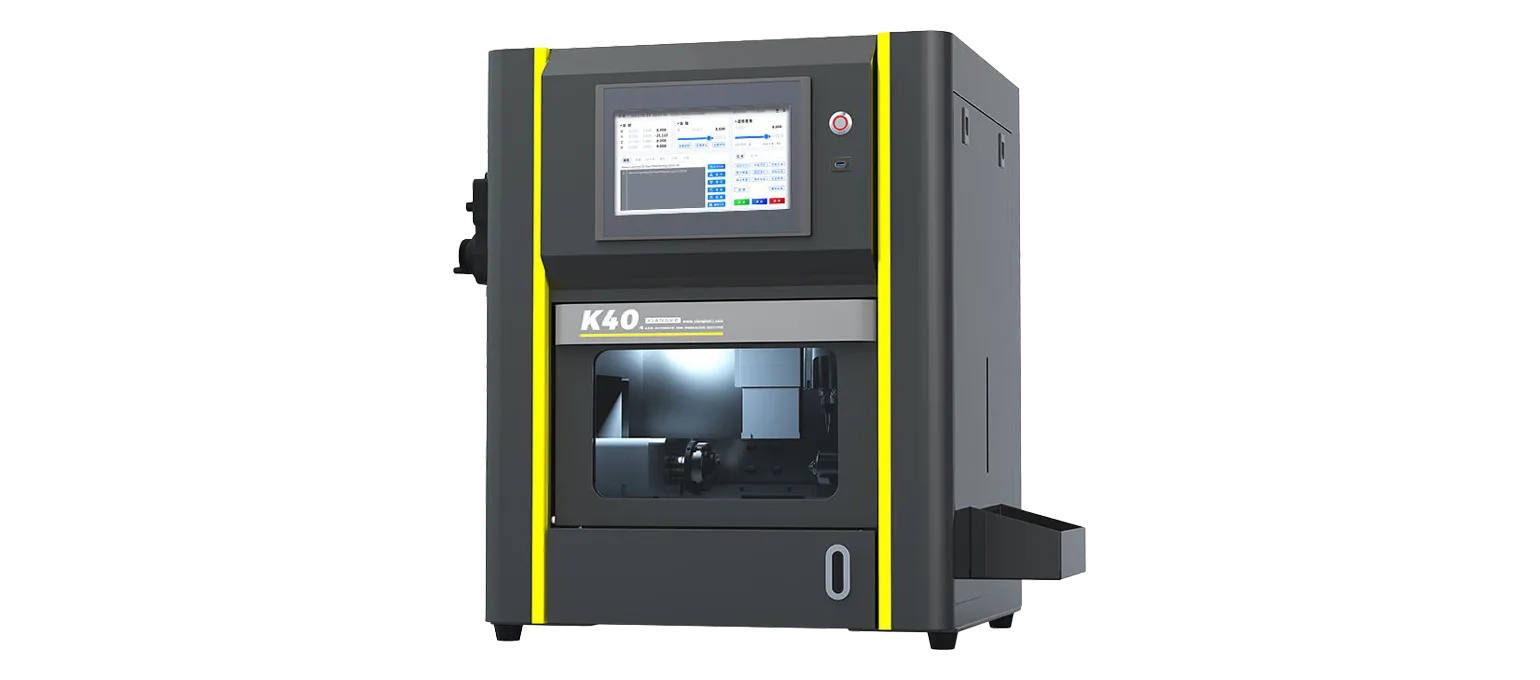
| Desktop Engraver | K40 | K30, K40 | Small-part engraving and precision work |
Two practical notes on reading that table. First, a combo machine is a compromise by design: the tube attachment shares the gantry with the sheet table, so heavy simultaneous demand on both will queue. Shops running tube work more than about a third of the time usually end up wanting a dedicated tube machine. Second, the desktop K40 family sits in a different world entirely — small-part engraving, not production metal cutting — and does not belong in a comparison with the industrial series above it.
Beam time is only part of the cycle. The other part is loading, unloading, and clearing the previous nest.
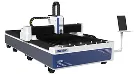
Single platform (A, F, FT series). One table. The operator loads, the machine cuts, the operator unloads, and the beam is idle the entire time the door is open. For job-shop work with mixed short runs and frequent program changes, that idle time is absorbed by the setup anyway.
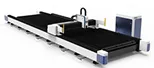
Exchange table (E, P, PT series). Two pallets. One is under the beam while the other is being unloaded and reloaded outside the enclosure. The gain scales with how repetitive your production is: on long runs of the same nest, exchange tables recover a meaningful share of the shift; on one-off fabrication with long programming pauses, the payback stretches out.
Full enclosure (P, PT series). Required in most jurisdictions once you move to higher power classes, and useful regardless for fume containment and Class 1 operation. Enclosure also constrains how you get oversized material in, which is worth checking against your crane layout before ordering.
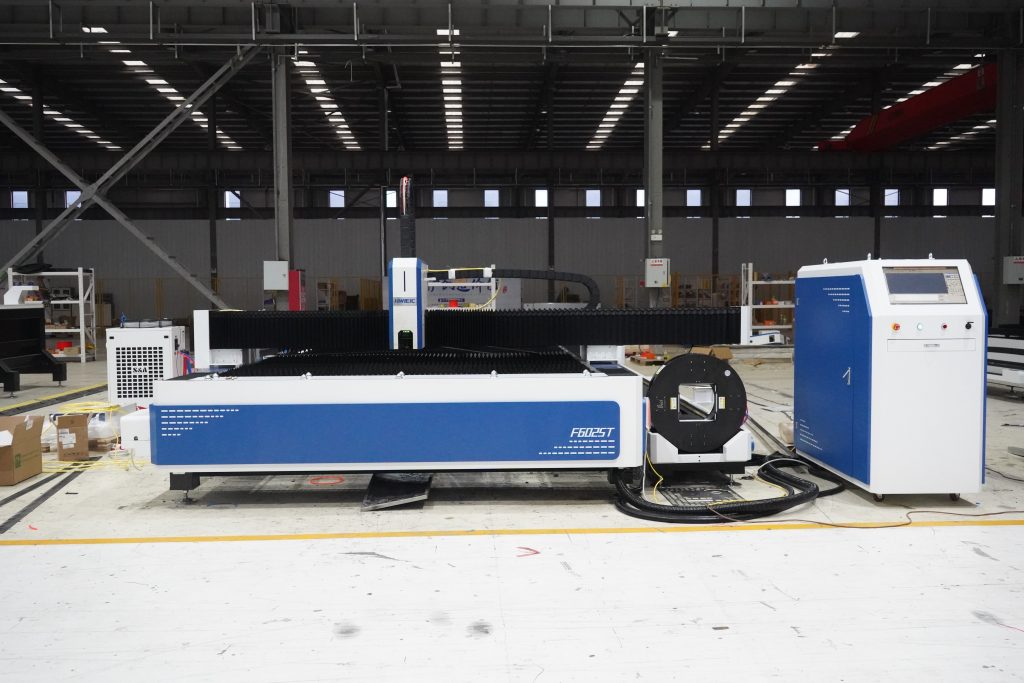
Buyers often start with a target: “I need to cut 20 mm mild steel, what kilowatt do I need?” The honest answer is that the number depends on the assist gas, the nozzle, the material grade and surface condition, and the edge quality you will accept — and that any manufacturer’s published thickness figure is a maximum under favorable conditions, not a production rate.
A more useful sequence:
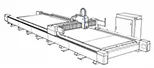
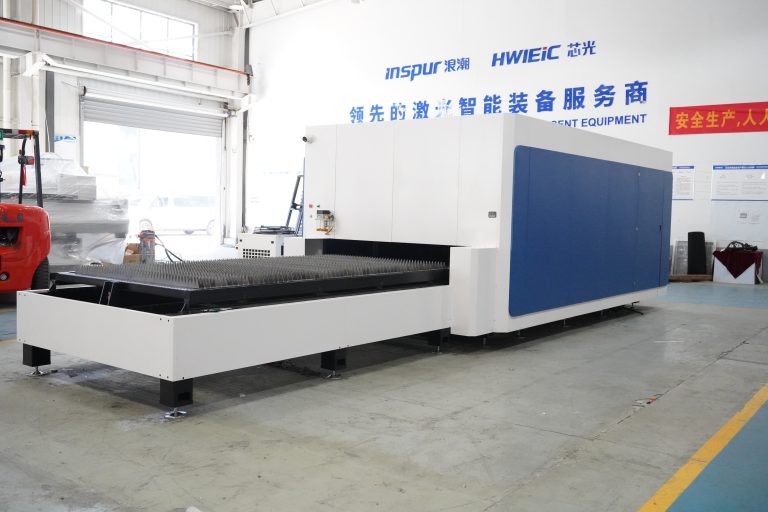
The G8025 6KW is a large-format fiber cutting configuration within HWlEiC Laser’s G Series, deployed in metal processing and shipbuilding-related fabrication where plate sizes exceed what a standard 3000 × 1500 mm table accommodates.
What is confirmed in HWlEiC Laser’s published material:
What is not published, and what you should therefore request in writing before ordering:
Note that G8025 is not among the three model numbers published on the G Series page (G9020, G12030, G15530). The G Series is documented as supporting customizable working dimensions, so a configured build is the likely explanation — but confirm the exact working area rather than inferring it from the model designation. Model naming conventions are not standardized across the industry and should never be read as a dimension guarantee.
For most sheet fabricators, a 6 kW class machine in a large format sits at a specific point in the market: enough power that nitrogen cutting on mid-thickness stainless stays productive, and enough table to handle plate that would otherwise need pre-cutting. If your plate rarely exceeds standard sheet size, the same power in an F, E, or P series footprint will cost less to buy and less to floor.
HWlEiC Laser publicly displays ISO 9001:2015 quality management system certification, CE compliance, and RoHS compliance.
ISO 9001:2015 is a management system standard. It certifies that documented processes exist and are followed for design, production, and corrective action. It is not a product performance standard, and it does not certify that any individual machine meets a cutting specification — a distinction worth understanding when a supplier offers a certificate in place of a test result.
CE compliance addresses conformity with applicable European directives, which for laser cutting equipment brings in machinery safety and, for enclosed systems, laser safety classification. RoHS addresses restricted substances in the equipment itself.
Certificate numbers and issuing organizations are not published on HWlEiC Laser’s public pages. Request copies of the certificates themselves, with numbers and issuing bodies, during due diligence. That request is routine and any established manufacturer should meet it without friction.
Q: Can a fiber laser cutting machine cut copper and brass?
A: Yes, with appropriate head protection and process settings. Reflective metals send more energy back toward the optics than steel does, which is why back-reflection protection matters. Confirm that the specific head and source configuration being quoted is rated for the reflective materials you run.
Q: How much does a laser cutting machine cost?
A: HWlEiC Laser does not publish pricing. Cost depends on laser power, working area, machine configuration, automation requirements, and the material application, so quotation requires a customized evaluation. Ask for the quotation to itemize the source, table type, enclosure, and automation separately so you can compare offers on equivalent terms.
Q: What is the difference between an exchange table and a single platform machine? A: An exchange table machine has two pallets, so one can be loaded and unloaded outside the enclosure while the other is under the beam. A single platform machine has one table, and the laser is idle during loading. The E, P, and PT series use exchange platforms; the A, F, and FT series use single platforms.
Q: Do I need a separate machine for tube cutting? A: Not necessarily. The ET, FT, and PT series handle both sheet and tube on one machine. If tube work is a large and steady share of your production, a dedicated tube machine from the T, TE, or K series avoids scheduling conflicts between the two workloads.
Q: What maintenance does a fiber laser cutting machine need?
A: Routine items include nozzle inspection and replacement, protective glass checks, lens cleanliness, chiller coolant condition and filter changes, and lubrication of guide rails and racks. Fiber delivery removes the mirror alignment routine required by mirror-path systems, which is a meaningful reduction in scheduled maintenance labor.
Q: What power do I need to cut 10 mm mild steel?
A: The answer depends on assist gas, nozzle, material grade, and the edge quality you require, so no single kilowatt figure applies universally. Request a cutting capacity chart tied to the exact configuration being quoted, and validate it with a sample cut on your own material.
Q: Are HWlEiC Laser machines certified?
A: HWlEiC Laser publicly displays ISO 9001:2015 quality management system certification, along with CE and RoHS compliance.
A metal-focused buyer's guide to laser cutting machines: material behaviour, thickness lim…
pelajari lebih lanjut
A laser cutting machine focuses a high-energy beam onto metal, melting a narrow kerf while…
pelajari lebih lanjut
Kami akan membalas Anda dalam waktu 24 jam. Jika untuk kasus mendesak, silakan tambahkan WhatsApp / WeChat: +86 15589913375. Atau hubungi +86 15589913375 secara langsung.
*Kami menghormati kerahasiaan Anda dan semua informasi dilindungi.
Kami hanya akan menggunakan informasi Anda untuk menanggapi pertanyaan Anda dan tidak akan pernah mengirim email atau pesan promosi yang tidak diminta.
Dinamika dan efisiensi tertinggi
Daya tahan dan keandalan
Presisi dan akurasi yang ditingkatkan
Cerdas & mudah digunakan
Keamanan & sehat
Otomatisasi serbaguna