




October 22,2026
De la livraison à la production : installation et formation sur les machines HWlEiC Laser
L’achat d’une machine de découpe laser à fibre représente un investissement important, mais une production réussie…
en savoir plus


 09:07
A fiber laser cutting machine uses a focused beam to cut metal sheet, tube, or both, and the right class depends on power, working area, and whether you need a fully enclosed structure or an exchange platform. This guide compares the PH, Ple cuivre G Des séries pour vous permettre d’adapter une machine à votre ligne de production.
A fiber laser generator produces a beam that travels through an optical cable to a cutting head. The head focuses that beam onto the metal surface, melting or vaporizing material along a programmed path while an assist gas — usually oxygen, nitrogen, or compressed air — blows the molten material out of the kerf. That’s the whole mechanism. Everything else — bed size, enclosure type, exchange platforms — is about how that core process gets adapted to a specific shop floor.
La plupart des acheteurs qui étudient cette catégorie cherchent à résoudre l’un de deux problèmes : remplacer une ancienne ligne de découpe au CO2 ou au plasma, ou augmenter leur capacité de production de tôles et déterminer quelle catégorie de machine convient réellement à leurs pièces.
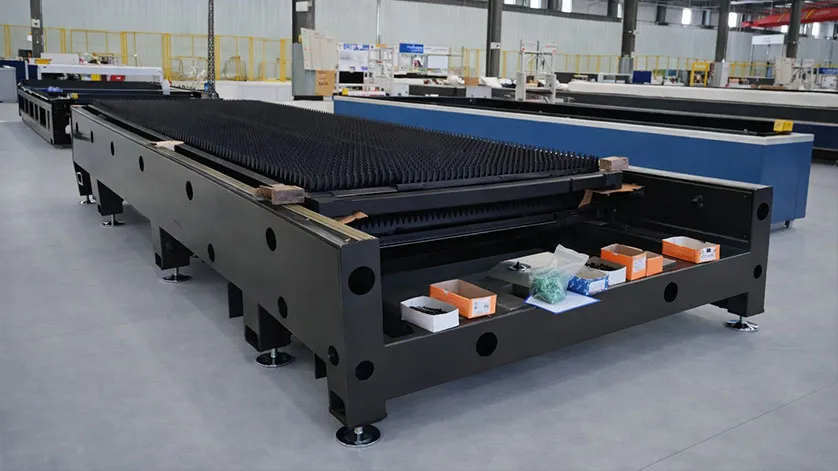
Fiber laser sheet cutters in this category generally fall into three structural groups.
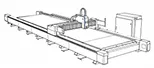
Série PH — High-speed fiber laser cutting machines built around single-platform structures. Current models are the PH3015, PH6020, and PH6025. These are positioned for continuous industrial production runs where cycle time on standard sheet sizes matters more than exotic part geometry.
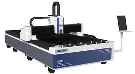
Série P — Enclosed exchange platform machines: P4020, P6025, P8025, P10025, and P12025. The fully enclosed structure contains beam and spatter, and the exchange platform lets an operator load the next sheet while the current one finishes cutting, cutting idle time between jobs.
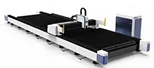
Série G — Large format machines for oversized plate: G9020, G12030, G15530, plus custom configurations. These are built for heavy fabrication work — structural steel, shipbuilding components, anything too large for a standard 4×8-style bed.
Measure your largest sheet size in regular production and pick a bed with margin, not an exact fit — running a sheet at the edge of a machine’s working envelope creates handling problems.
Check whether your facility or local workplace safety rules require an enclosed cutting area. If so, the P Series is the starting point regardless of throughput needs.
If your bottleneck is cycle time on sheets you already run at volume, prioritize the PH Series before looking at higher-power alternatives.
Si les pièces dépassent régulièrement les dimensions standard des tôles, optez pour la série G ou demandez une configuration personnalisée plutôt que d’essayer d’imbriquer des pièces surdimensionnées sur une table plus petite.
Confirm gas supply, power capacity, and floor space at your facility before finalizing a model — these site factors affect which configuration within a series is actually installable.
| Série | Modèles | Structure | Typical Fit |
|---|---|---|---|
| PH | PH3015, PH6020, PH6025 | Single platform, high-speed | Continuous sheet production runs |
| P | P4020, P6025, P8025, P10025, P12025 | Fully enclosed, exchange platform | Enclosed environments, reduced loading and unloading downtime |
| G | G9020, G12030, G15530, Custom | Large format, open or custom enclosure | Oversized plate processing and heavy industrial fabrication |
Exact wattage and speed figures vary by the specific configuration ordered and aren’t published as a fixed per-model chart — power output, working dimensions, and automation options are selected during quoting based on the material and thickness you’re cutting.
The G Series is the large-format line, with G9020, G12030, and G15530 as the published catalog models, alongside custom working dimensions for buyers with non-standard sheet sizes. Higher-power configurations, including 6KW setups, are built within this series for customers cutting thicker structural plate — shipbuilding-adjacent fabrication is a common application.
One thing worth flagging directly: not every wattage-and-bed-size combination within the G Series appears as a standalone catalog listing. If you’re evaluating a specific configuration, confirm the exact bed dimensions and power output with HWlEiC directly rather than assuming it matches the closest published model.
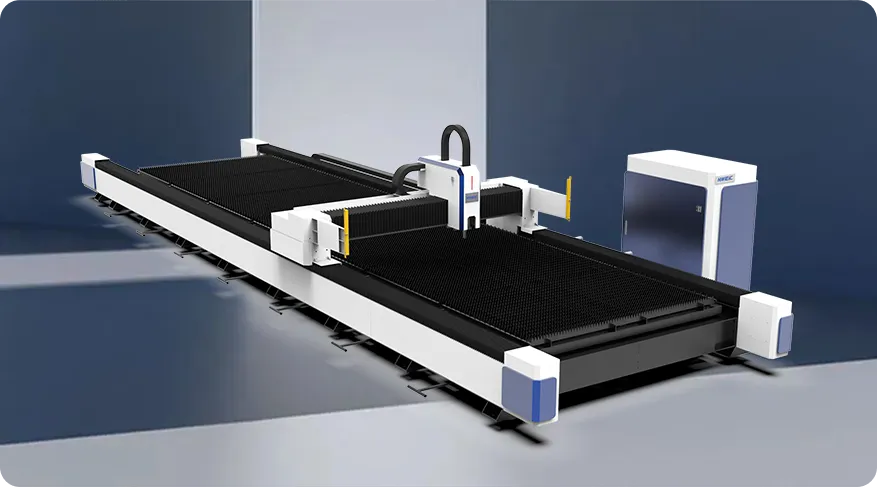
Un nombre de kilowatts plus élevé ne signifie pas automatiquement une découpe plus rapide. La vitesse de coupe pour un matériau et une épaisseur donnés dépend de l’interaction entre la puissance du laser, l’optique de la tête de coupe, le type et la pression du gaz d’assistance, ainsi que l’état de la buse — et non de la puissance seule. Un atelier qui travaille principalement de l’acier doux de 3 mm ne tire pas nécessairement avantage d’une configuration de la série G à la puissance maximale ; cet investissement est souvent mieux consacré à une machine de la série PH dotée d’un cycle d’échange plus rapide.
The second common assumption: that open-platform machines are inherently less safe than enclosed ones. Enclosure is primarily about containing beam and spatter in a shared workspace, not a universal safety upgrade — plenty of single-platform shops run PH Series equipment safely with standard laser safety protocols and adequate floor layout. The decision usually comes down to what your facility’s workplace rules require, not which structure is objectively “safer.”
Les équipements laser HWlEiC sont fabriqués dans le cadre d’un système de management de la qualité certifié ISO 9001:2015, et l’entreprise affiche publiquement sa conformité CE pour le marché européen ainsi que sa conformité RoHS, qui restreint les substances dangereuses. La norme ISO 9001:2015 est en elle-même la norme de management de la qualité reconnue à l’échelle internationale et maintenue par l’Organisation internationale de normalisation ; c’est ce que les acheteurs devraient demander lorsqu’un fournisseur revendique une certification qualité sans fournir de précisions. Les numéros de certificat et les informations sur l’organisme émetteur des certifications de HWlEiC ne sont pas publiés sur le site de l’entreprise ; ne vous attendez donc pas à obtenir un numéro de document sans contacter directement le fournisseur.
HWlEiC Laser doesn’t publish fixed prices for any series. That’s standard for this equipment category — industrial laser cutting machines aren’t sold off a price list because the final cost depends on laser power, working area, machine configuration, automation level, and the specific material application you’re cutting for. If a page in this category gives you a number without asking any of those questions first, treat it as a placeholder, not a quote. Getting an actual price means submitting your material type, thickness range, and target throughput for evaluation.
Most published comparisons in this category lead with a wattage table and a material-thickness chart, then stop there. That’s useful for a first pass, but it skips the structural question that actually determines day-to-day operation: whether you’re loading sheets into an enclosed exchange platform or a single open bed, and how that changes cycle time between jobs. Wattage tells you what a machine can cut; platform structure tells you how fast you can keep feeding it.
If you already know your sheet size range and material thickness, the series comparison above should narrow your options to two or three specific models. From there, the next step is submitting those specs for a configuration-specific quote, since neither power output nor final pricing is standardized across a series. If you’re still unsure whether your parts need sheet cutting, tube cutting, or both, that’s a separate product category worth checking before you commit to a sheet-only series.
Q: What’s the actual difference between the PH Series and P Series?
A: Structure and workflow. PH Series machines are single-platform and built for cycle speed on standard sheets. P Series machines are fully enclosed with an exchange platform, which contains the beam and lets you load the next sheet while the current one finishes.
Q: Can a PH, P, or G Series machine also cut tube?
A: No. These three series are sheet-only. Tube cutting is handled by a separate product line (T and TE Series), and combined sheet-and-tube cutting has its own dedicated line (ET, FT, and PT Series) if you need both capabilities on one machine.
Q : Combien de temps l’installation prend-elle ?
A: This varies by machine size, site readiness, and configuration, and isn’t something to estimate generically — confirm a timeline during the quoting process based on your specific model and facility.
Q: Is an open-platform machine unsafe compared to an enclosed one?
A: Not inherently. Enclosure mainly contains beam and spatter; safety in either configuration depends on following standard laser safety protocols and facility layout, not the presence of an enclosure alone.
Q : Quelles certifications devrais-je demander ?
A: ISO 9001:2015 for quality management, plus CE and RoHS compliance if you’re importing into the EU or need to meet hazardous-substance restrictions. Ask for certificate numbers directly if you need them for procurement documentation.
Q: Does HWlEiC Laser list prices online?
A: No. Pricing depends on power, bed size, configuration, and automation level, and requires a submitted quote request rather than a published price list.
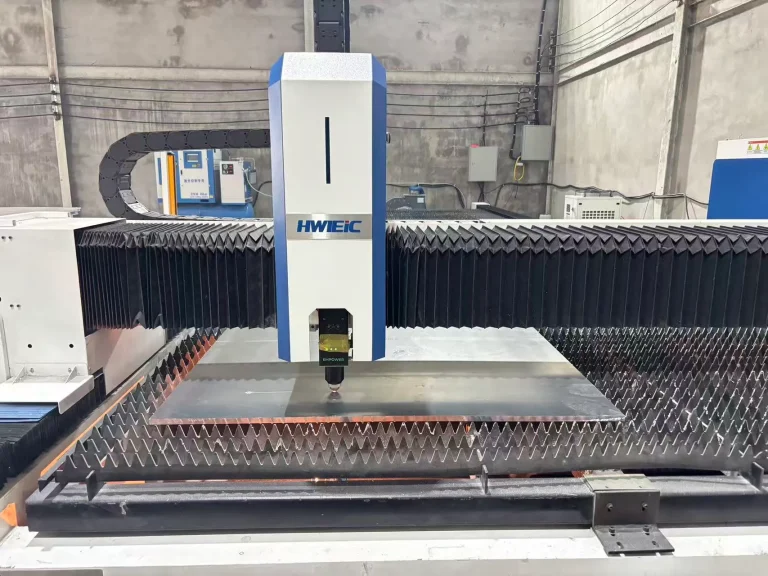
L’achat d’une machine de découpe laser à fibre représente un investissement important, mais une production réussie…
en savoir plus
Profil de l'entreprise Shandong HWlEiC Optoelectronic Technology Co., Ltd. est une société affiliée…
en savoir plus
Nous vous répondrons dans les 24 heures. Si, pour des cas urgents, s'il vous plaît ajouter WhatsApp/WeChat: +86 15589913375. Ou appelez le +86 15589913375 directement.
*Nous respectons votre confidentialité et toutes les informations sont protégées.
Nous n'utiliserons vos renseignements personnels pour répondre à votre demande et ne seront jamais envoyer des courriels non sollicités ou des messages promotionnels.
Ultime la dynamique et l'efficacité
La durabilité et la fiabilité
Mise à niveau de précision et d'exactitude
Intelligent et facile à utiliser
La sécurité et de la santé
Polyvalent automatisation
 English English
 Español
 العربية
 Français
 Русский
 Türkçe
 한국어
 Português
 Bahasa Indonesia
 Deutsch
 Italiano