














July 30,2026
CNC Sheet Metal Laser Cutting Machine: Buyer’s Guide
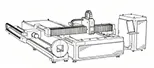
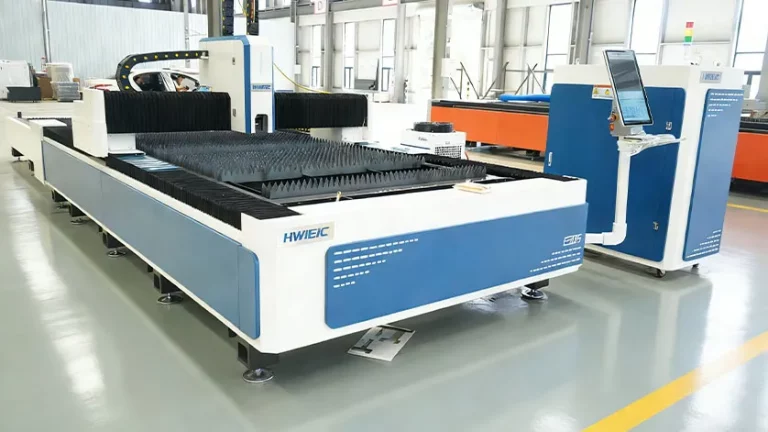
A CNC sheet metal laser cutting machine uses a fiber laser and a numerically controlled mo…
erfahren Sie mehr


 15:29
15:29 Ein CNC sheet metal laser cutting machine uses a fiber laser and a numerically controlled motion system to cut flat metal blanks to programmed geometry. For fabricators, the two decisions that matter most are work-area footprint and whether the machine uses a single fixed table or an exchange table.
Evething else on a spec sheet is negotiable configuration. Those two choices are structural, and changing your mind after installation means either a second machine or a rebuilt bay.
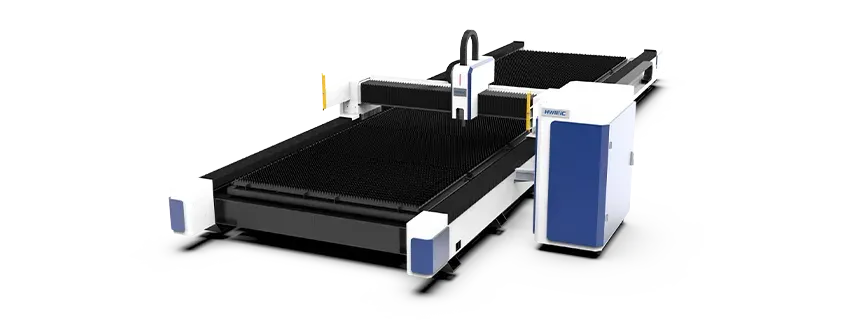
Model designations in this category encode nominal work area, not power. The first pair of digits is the X-axis travel in metres, the second pair is the Y-axis width. A 4020 machine addresses a 4000 mm × 2000 mm blank; a 6025 addresses 6000 mm × 2500 mm.
That convention is worth internalising before you compare quotes, because two suppliers can list the same designation on machines with very different laser sources, drive systems, and cutting heads behind it.
| Series | Catalogue Positioning | Table Design | Models |
|---|---|---|---|
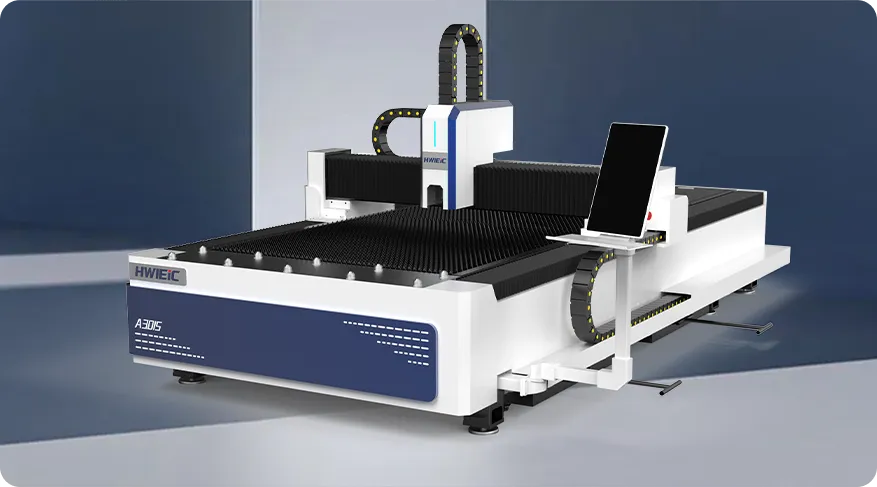
| Serie | Basic single-plane laser cutting machine | Single fixed platform | A3015, A4015, A4020, A6025 |
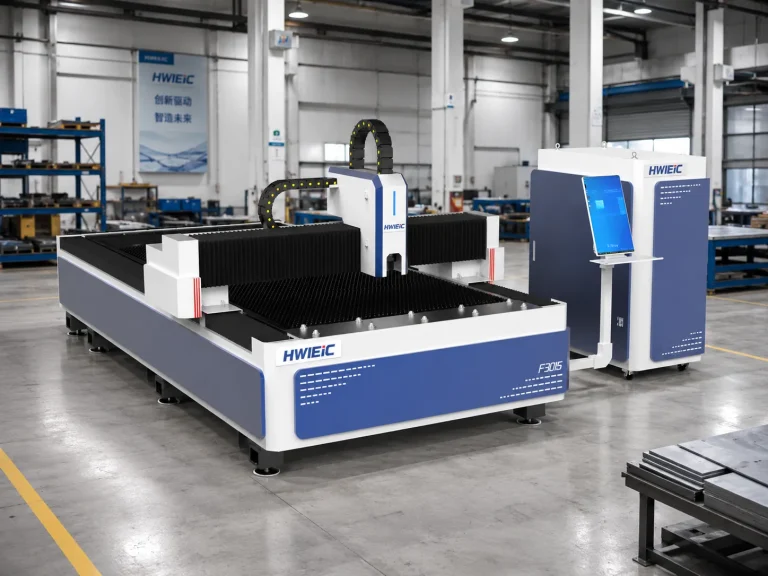
| F-Serie | Classic single-plane laser cutting machine | Single fixed platform | F3015, F4020, F6015, F6025 |
| E-Serie | Exchange-platform fiber laser cutting machine | Twin exchange table | E3015, E4015, E4020, E6015, E6025 |
Table 2 — Nominal work area by designation
| Designation | Nominal Work Area (mm) | Approx. Imperial | Available in |
|---|---|---|---|
| 3015 | 3000 × 1500 | 10 ft × 5 ft | A, F, E |
| 4015 | 4000 × 1500 | 13 ft × 5 ft | A, E |
| 4020 | 4000 × 2000 | 13 ft × 6.5 ft | A, E, F |
| 6015 | 6000 × 1500 | 20 ft × 5 ft | F, E |
| 6025 | 6000 × 2500 | 20 ft × 8 ft | A, F, E |
Note the gaps. There is no A6015 or F4015 in the published range, so a shop that has standardised on 6000 × 1500 stock is choosing between the F-Serie fixed table and the E-Serie exchange table, not across all three.
Confirm the millimetre figures on your own quotation rather than treating the designation as a contract. Frame sizes get revised; naming conventions outlive them.
Laser power, rapid traverse speed, positioning accuracy, and repeatability are not published per model on the HWlEiC Laser catalogue pages. They are set during configuration and stated on the quotation. Maximum cut thickness is likewise absent, and that omission is more defensible than it looks: a thickness figure means nothing without the assist gas, the nozzle, the edge quality you will accept, and whether the number describes a pierce-and-cut in production or a one-off demonstration.
Compared with the typical listings from large industrial equipment suppliers in this category, which lead with headline work area and headline maximum wattage, the useful comparison is narrower: what power does this machine need to run your thickest regular material at your required edge quality, with nitrogen or oxygen priced at your local rate.
Ask for four things in writing before you compare prices:
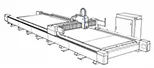
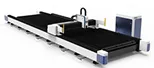
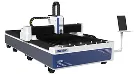
The A and F-Serie use one fixed platform. You cut, the machine stops, you unload, you load, you cut again. The E-Serie runs two tables that swap, so loading and unloading happen on one table while the beam works on the other.
An exchange table converts non-cutting minutes into cutting minutes. It only does so under conditions many buyers skip past:
Short cycles with heavy manual sorting at the table, single-operator night shifts, and low-mix job work all erode the gain. A fabricator running 20-minute nests with a dedicated loader gets a different answer than a job shop cutting one-off brackets between other work.
Step five is where installation schedules slip most often. Electrical and gas infrastructure has a lead time of its own, and it does not compress to match a shipping date.
“A bigger table is never a mistake.” It is, on small parts. Longer traverses between cuts, more extraction volume to move and filter, more floor space, and more money tied up in a frame that runs half-loaded. Oversizing is the most common regret in this category, and it is the hardest to reverse.
“An exchange table pays for itself automatically.” It pays for itself when the constraint is table time. If the constraint is programming, material supply, deburring, or bending capacity, the extra parts per shift pile up at the bottleneck instead of shipping.
“Edge case worth planning for: small parts and thin sheet”. Parts below roughly a hand’s width tip into the slat gaps, and thin material warps and drops before the cut finishes. Nesting strategy, tab retention, and slat spacing matter more than laser power here. Long narrow parts have the mirror problem — they cut fine and then bend as you lift them off the table. If either describes a meaningful share of your work, put those exact parts in the sample request rather than a demonstration plate.
HWlEiC Laser holds ISO 9001:2015 quality management system certification, and declares CE and RoHS compliance for its equipment. ISO 9001:2015 is the quality management system standard, and CE marking covers conformity requirements for the European market.
Certificate numbers and issuing bodies are not published on the public pages. Request scanned copies of the certificates with the quotation and check the scope statement against the product category you are buying — certification scope is where paperwork and reality most often diverge.
Also ask what happens after commissioning. Factory inspection before shipment, machine testing, and on-site or remote technical guidance are part of the standard support model, and the details belong in the contract rather than in an email thread.
Fixed platform (A and F Series). Lower purchase price, shorter machine length, fewer mechanical subsystems to maintain. In exchange, the beam idles during every load and unload cycle, and the operator works at the table where hot parts and slag are.
Exchange platform (E Series). Higher utilisation on long cycles, safer separation between loading and cutting. In exchange, a higher price, a longer bay, a table-transfer mechanism that adds maintenance points, and no benefit at all if material handling upstream cannot keep both tables fed.
The A and F Series positioning also differs in intent: A is catalogued as the basic single-plane machine, F as the classic single-plane machine with high-precision processing for stable production. Where your tolerance requirements sit will point to one or the other; ask for the accuracy figures in Table 1’s terms and compare them directly.
HWlEiC Laser does not publish price ranges for this category, and any figure you find quoted elsewhere for “a 4020 laser cutter” is describing a configuration, not a machine. Pricing is evaluated per enquiry against laser power, working area, machine configuration, automation requirements, and the material application.
To get a quote that survives comparison, send five items: material types and thickness range, monthly volume by thickness, largest and most common blank sizes, required edge quality or downstream process, and available floor space with utility capacity. A supplier who quotes without asking for those is quoting a frame, not a solution.
Send three or four of your genuinely difficult parts for a sample cut, and ask for the parameter set alongside the samples. Parts that already cause scrap on your current process tell you more in one test than any spec table.
Two topics this guide has not covered and that change the sizing maths: tube and profile work, which moves you toward the dedicated tube ranges or the sheet-and-tube combo machines rather than a flat-sheet machine, and automated loading and unloading, which changes the exchange-table calculation entirely by removing the operator from the cycle. Both deserve their own evaluation before you fix a budget.
Q: What do the numbers in model names like A4020 or E6025 mean?
A: They encode nominal work area in millimetres. A4020 addresses a 4000 mm × 2000 mm blank, E6025 addresses 6000 mm × 2500 mm. The letter indicates the series and table design. Usable nesting area is slightly smaller than the nominal figure once clamping and edge margin are accounted for.
Q: Should I choose a single-platform or exchange-table machine?
A: Choose the exchange table when table time is your bottleneck, cut cycles are long enough that the swap overhead is minor, and you have staged material plus someone loading during the cut. Choose a single platform when cycles are short, mix is low, or a single operator covers the machine alongside other work.
Q: How much does a CNC sheet metal laser cutting machine cost
A: HWlEiC Laser does not publish prices for this category. Cost is evaluated per enquiry based on laser power, working area, machine configuration, automation requirements, and material application, so a quotation is required. Send your material and thickness mix with the enquiry to get a comparable number.
Q: What laser power do I need for 10 mm carbon steel?
A: Power ratings are not published per model and are matched during configuration. The honest answer depends on assist gas, required edge quality, pierce time you will tolerate, and how often 10 mm runs versus your thinner material. Ask for a sample cut in that thickness with the parameters disclosed.
Q: Can these machines also cut tube and profile?
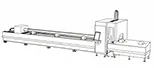
A: No. The A, F, and E Series are flat-sheet machines. Tube work is handled by dedicated tube cutting ranges, and mixed sheet-and-tube production by the combo machine series. Buying a flat-sheet machine and adding a rotary attachment later is rarely a satisfactory substitute for either.
Q: What certifications should I ask to see?
A: Request the ISO 9001:2015 certificate and the CE and RoHS declarations, and read the scope statement on each to confirm it covers the equipment category you are buying. Certificate numbers and issuing bodies are not published publicly, so ask for scans rather than relying on a logo on a web page.
A CNC sheet metal laser cutting machine uses a fiber laser and a numerically controlled mo…
erfahren Sie mehr
CNC laser cutting machines come in fiber, CO2, and crystal types. Compare how each perform…
erfahren Sie mehr
Wir werden Antwort Sie innerhalb 24 Stunden. Wenn für dringenden Fall, fügen Sie bitte WhatsApp/WeChat: +86 15589913375. Oder rufen Sie +86 15589913375 direkt.
*Wir respektieren die Vertraulichkeit und alle Informationen geschützt sind.
Wir verwenden Ihre Informationen nur zur Beantwortung Ihrer Anfrage und sendet niemals unaufgefordert E-Mails oder Werbe-Nachrichten.
Ultimative Dynamik und Effizienz
Haltbarkeit und Zuverlässigkeit
Präzision und Genauigkeit aktualisiert
Intelligente & Benutzerfreundlichkeit
Sicherheit & gesund
Flexible automation