















October 22,2026
From Delivery to Production: HWlEiC Laser Machine Installation and Training
Purchasing a fiber laser cutting machine is an important investment, but successful produc…
erfahren Sie mehr


 18:23
18:23 HJ, HS, and HA are HWlEiC Laser’s three handheld welding lines, separated by build purpose rather than one spec sheet: HJ targets general handheld fabrication work, HS is the compact option for smaller shops, and HA is the base handheld platform. None list public wattage data, so selection depends on quoted specs.
Most comparison posts for this equipment category line up wattage and duty cycle side by side. That approach doesn’t work here yet, because HWlEiC’s published pages don’t carry power ratings, beam quality, or dimensions for any of the three handheld lines. What they do carry is positioning language, and that positioning is specific enough to sort buyers into a starting lane before a quote conversation happens.
| Series | Published Positioning | Confirmed Features | Power / Dimensions |
| HJ Series | Handheld Fiber Laser Schweißen Maschine | Handheld welding solution built for metal fabrication applications | Not publicly listed — request a quote |
| Der HS-Serie | Mini Handheld Laser Welder | Compact design; positioned for small businesses and flexible welding applications | Not publicly listed — request a quote |
| HA Series | Handheld Laser Welding Machine | Listed on multilingual product pages; no distinguishing feature information published beyond the series name | Not publicly listed — request a quote |
That last row matters more than it looks. HA is a real, named series in HWlEiC’s catalog, but the public pages don’t give it a feature description the way HJ and HS get one. If a buyer is choosing between HA and the other two purely from published content, there isn’t enough there to differentiate it yet — the honest answer is to treat HA as a line to ask about directly rather than to compare feature-for-feature against HJ and HS.
HJ is described as a handheld fiber laser welding machine aimed at metal fabrication applications. There’s no qualifier in the published material — no “mini,” no “compact,” no automation add-on — which reads as the general-duty option in the lineup. Shops running mixed jobs (different metal thicknesses, different joint types, day-to-day fabrication rather than one repeated part) fit the description as written.
What isn’t published: amperage or wattage tiers, wire feed specs, or duty cycle. A shop deciding between HJ and a higher-output option should get those numbers in writing before ordering rather than assuming HJ covers heavier-gauge work.
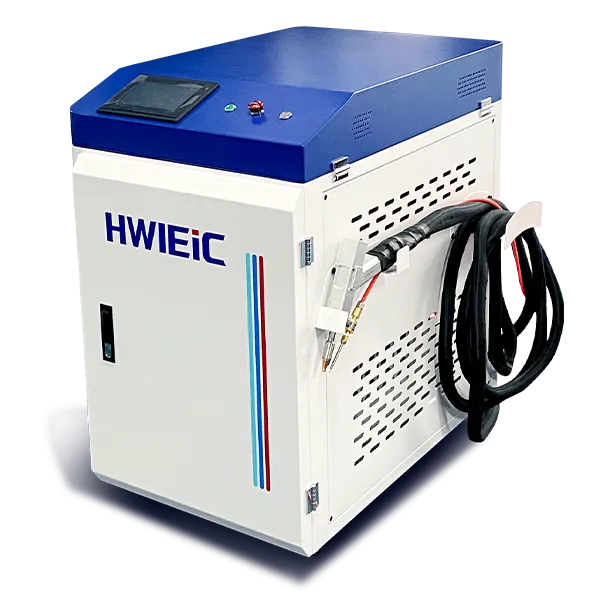
Der HS-Serie is the one series where the published copy makes a functional claim beyond “handheld”: compact design, positioned for small businesses and welding work that needs to move around a shop floor.
Read literally, HS is the fit for two situations:
Where the comparison breaks down is duty cycle. Compact equipment in this category often trades continuous-run capacity for portability, but HWlEiC hasn’t published that trade-off for HS specifically. A shop planning to run it for long stretches, not just short jobs, should confirm continuous-duty numbers before assuming “mini” only means smaller footprint.
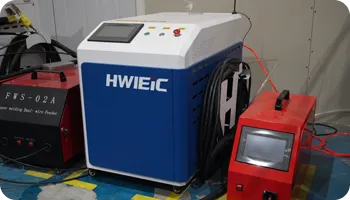
HA Series carries the positioning “Handheld Laser Welding Machine” — the same generic label HJ uses — and sits on multilingual product pages, which points to it being sold across more than one regional storefront. Beyond that, there’s no published feature list, no model numbers, and no stated use case that distinguishes it from HJ.
This isn’t a case of the product being lower-tier or newer; the public record is simply thinner than HJ’s or HS’s. Buyers evaluating HA should ask HWlEiC directly what separates it from HJ before assuming it’s interchangeable, since two series with near-identical public descriptions can still differ on power range, control interface, or wire feed system once you get the quote.
A common assumption is that any handheld welder — HJ, HS, or HA — is the wrong tool once production volume climbs, and that robotic welding is the only real option for repeat parts. HWlEiC’s own lineup argues against treating that as a hard rule: the HJ-R Series is a robotic laser welder built specifically for production-line integration, sitting one tier above the handheld lines for exactly that use case.
In practice, that means the real decision isn’t “handheld vs. not handheld” — it’s whether the job is variable (different parts, different joints, operator judgment needed) or repeatable (same weld, same part, high volume). Variable work stays with HJ, HS, or HA. Repeatable, high-volume work is a conversation about HJ-R, not about which handheld unit has more power.
Not confirmed either way. “Mini” in HWlEiC’s published copy refers to the compact form factor, not a stated power tier. Power specs for both series aren’t published, so this needs to be confirmed directly rather than assumed from the name.
HWlEiC’s public pages don’t spell that out yet. Until model-level specs are published or provided in a quote, treat HA as a separate line to ask about rather than a variant of HJ.
They’re built as handheld units for variable, operator-driven work. HWlEiC’s HJ-R Series is the robotic line positioned for production-line integration, which is the more direct fit for repeatable, high-volume welding.
No. Pricing for HJ, HS, and HA runs on a quotation basis tied to configuration, power, and automation requirements — there’s no published range to quote here.
Based on published positioning alone, HJ is the one described without a size or use-case qualifier, which reads as the general-purpose option. That’s a reading of the public description, not a specific recommendation — confirming specs against your material thickness and duty cycle is still necessary before ordering.
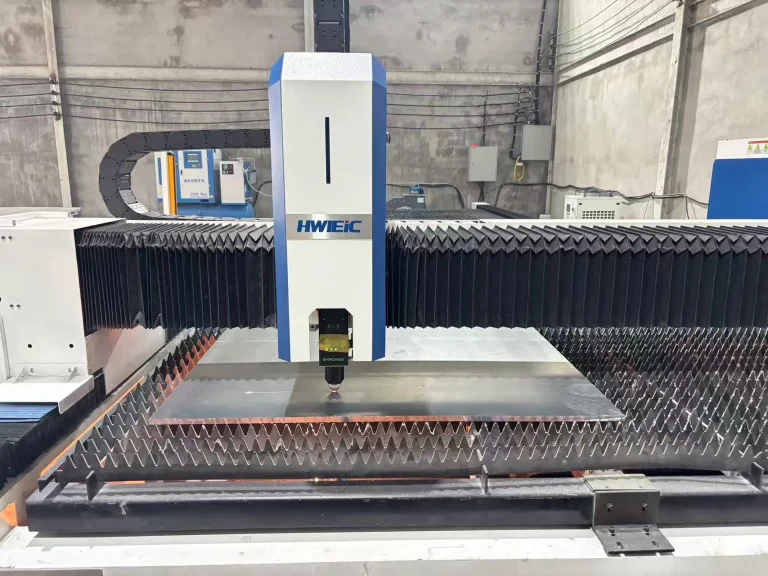
Purchasing a fiber laser cutting machine is an important investment, but successful produc…
erfahren Sie mehr

Company Profile Shandong HWlEiC Optoelectronic Technology Co., Ltd. is an affiliated compa…
erfahren Sie mehr
Wir werden Antwort Sie innerhalb 24 Stunden. Wenn für dringenden Fall, fügen Sie bitte WhatsApp/WeChat: +86 15589913375. Oder rufen Sie +86 15589913375 direkt.
*Wir respektieren die Vertraulichkeit und alle Informationen geschützt sind.
Wir verwenden Ihre Informationen nur zur Beantwortung Ihrer Anfrage und sendet niemals unaufgefordert E-Mails oder Werbe-Nachrichten.
Ultimative Dynamik und Effizienz
Haltbarkeit und Zuverlässigkeit
Präzision und Genauigkeit aktualisiert
Intelligente & Benutzerfreundlichkeit
Sicherheit & gesund
Flexible automation