















July 25,2026
Laser Cutting Machine Price: What Drives Cost
Laser cutting machine price isn’t a single number you can look up — it’s the o…
erfahren Sie mehr


 08:37
08:37 An industrial laser-Ausschnitt-Maschine has no fixed sticker price. Quotes are built from laser power, working area, platform type (single, exchange, or enclosed), automation level, and application requirements — HWlEiC Laser states plainly that every quotation requires a customized evaluation rather than a published price list.
| Factor | What It Changes | What to Specify When Asking for a Quote |
| Laser Power | Cutting speed, maximum material thickness, and laser source cost | The material types and thickness ranges you cut most frequently |
| Working Area | Machine bed size, required floor space, and sheet-handling method | The largest sheet or part size in your current production mix |
| Platform Type | Single platform, exchange table, or fully enclosed configuration | Whether loading and unloading time is currently a production bottleneck |
| Automation Level | Exchange platforms, automated loading systems, and production-line integration | The number of shifts and whether the machine connects to downstream processes |
| Application and Material | Cutting head configuration, assist-gas system, and fixturing | Material types, such as carbon steel, stainless steel, or aluminum |
| Installation and Training | On-site installation, factory inspection, commissioning, and operator training | Whether your operators have previous experience with fiber laser cutting equipment |
Single Platform vs. Exchange Platform: Where the Trade-Off Actually Bites
This is the trade-off most quotes turn on, and it’s a genuine one rather than a manufactured downside.
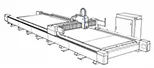
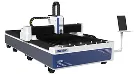
A single-platform machine — HWlEiC Laser’s A Series (A3015, A4015, A4020, A6025) is built this way — uses one fixed cutting bed. The operator loads material, the machine cuts, the operator unloads, and the cycle repeats. It’s a practical setup for shops running steady, moderate-volume sheet cutting where the cutting time itself is longer than the loading time, so idle time between cycles isn’t the bottleneck.
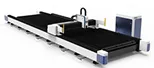
An exchange-platform machine, like HWlEiC Laser’s E Series, adds a second bed that swings into position while the first is being loaded or unloaded. That cuts idle time between cycles, but it adds a mechanical subsystem, more floor space, and cost. For a shop running thin material at high speed — where cutting time per sheet is short — the exchange platform can pay for itself in throughput. For a shop cutting thicker material at slower speeds, the single-platform A Series setup may sit idle less than expected, because the cutting cycle itself is already the longer step.
There’s no universally “better” choice here. It depends on which side of that cycle-time ratio your job mix falls on.
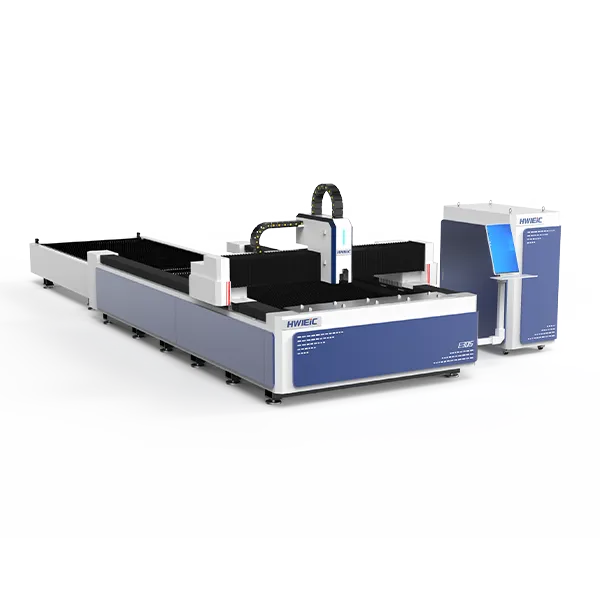
Buyers shopping by wattage alone often assume a “6kW machine” has one price across suppliers and configurations. It doesn’t. Two 6kW machines can differ substantially in total cost depending on whether one is a basic single-platform unit and the other is a fully enclosed, automated exchange-platform system. Power sets what the machine can cut; it doesn’t set what the machine is. Asking a supplier “what does a 6kW machine cost” without specifying platform, enclosure, and automation is close to asking a car dealer “what does a car with a V6 engine cost” — the engine is one line item among several.
Compliance isn’t free, and it’s often left out of price comparisons. HWlEiC Laser’s equipment is built to ISO 9001:2015 quality management standards and carries CE compliance marking for equipment sold into markets that require it. Quality system certification and CE conformity work (documentation, testing, and in some cases design changes) factor into the cost structure the same way automation or bed size does — they’re not decorative additions to a spec sheet.
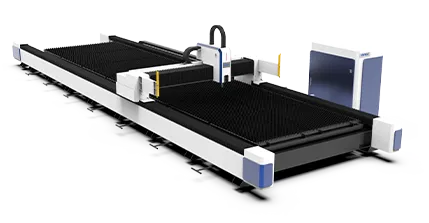
Compared to the fixed-price hobby and desktop cutter listings that dominate general search results — machines sold as a single configuration at a posted price — an industrial quote is closer to a construction bid than a checkout page. The posted-price model works when the buyer’s requirements match the seller’s one fixed SKU. Industrial buyers rarely have that match, because material, throughput, and floor space vary by facility.
The upside: a quote built around your actual material, volume, and floor space avoids paying for automation or bed size you won’t use. The downside: it takes longer than clicking “buy,” and it puts more responsibility on the buyer to specify requirements accurately — an incomplete spec sheet from your side produces an incomplete quote from the supplier’s side. Getting a usable number back means providing material type, thickness range, part size, and shift volume up front, not after the first quote comes back wrong.
HWlEiC Laser doesn’t publish price bands for industrial cutting equipment; every quotation requires a customized evaluation based on your material, power, and configuration needs. A rough range isn’t meaningful until platform type and automation level are set.
A: Not necessarily on its own. A high-power single-platform machine can cost less than a lower-power exchange-platform, fully enclosed system, because platform type and automation add cost independently of power.
The A Series is positioned as a basic single-platform machine for practical industrial sheet cutting, which suits shops that don’t yet need exchange-platform throughput. Confirm your material thickness and part size against the specific A-Series model before deciding.
Material type and thickness range, typical sheet or part dimensions, target production volume, and whether the machine needs to integrate with existing automation or a production line.
This varies by order. Confirm with the supplier whether factory inspection, on-site installation, and operator training are itemized separately or bundled into the quoted total before comparing numbers across suppliers.
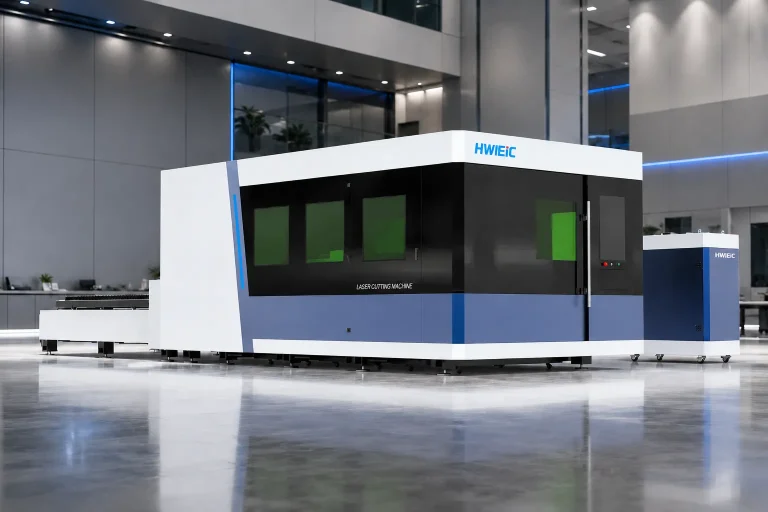
Laser cutting machine price isn’t a single number you can look up — it’s the o…
erfahren Sie mehr
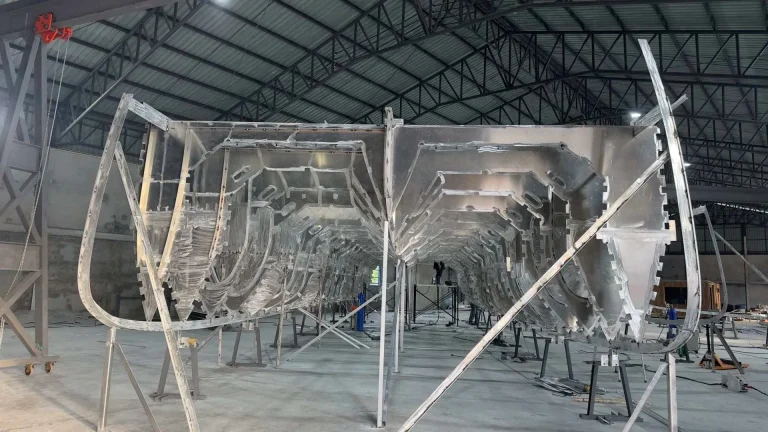
Thailand Customer Upgrades Metal Processing with HWlEiC G8025 6KW Fiber Laser Cutting Mach…
erfahren Sie mehr
Wir werden Antwort Sie innerhalb 24 Stunden. Wenn für dringenden Fall, fügen Sie bitte WhatsApp/WeChat: +86 15589913375. Oder rufen Sie +86 15589913375 direkt.
*Wir respektieren die Vertraulichkeit und alle Informationen geschützt sind.
Wir verwenden Ihre Informationen nur zur Beantwortung Ihrer Anfrage und sendet niemals unaufgefordert E-Mails oder Werbe-Nachrichten.
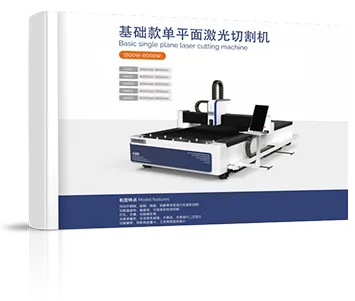
Ultimative Dynamik und Effizienz
Haltbarkeit und Zuverlässigkeit
Präzision und Genauigkeit aktualisiert
Intelligente & Benutzerfreundlichkeit
Sicherheit & gesund
Flexible automation